You hired a strong engineer, product manager, or designer. The offer is signed, the laptop is on its way, and everyone feels relieved. Then day one arrives, access is missing, the manager is pulled into meetings, and the new hire spends the afternoon reading a giant company wiki with no idea what matters. By day 45, the person is disengaged or already looking elsewhere.
That isn't a paperwork problem. It's a retention and time-to-productivity problem. Onboarding new hires should give people enough context to make good decisions, enough support to build confidence, and enough ownership to prove they belong. A fast-growing startup can't afford to leave those outcomes to chance.
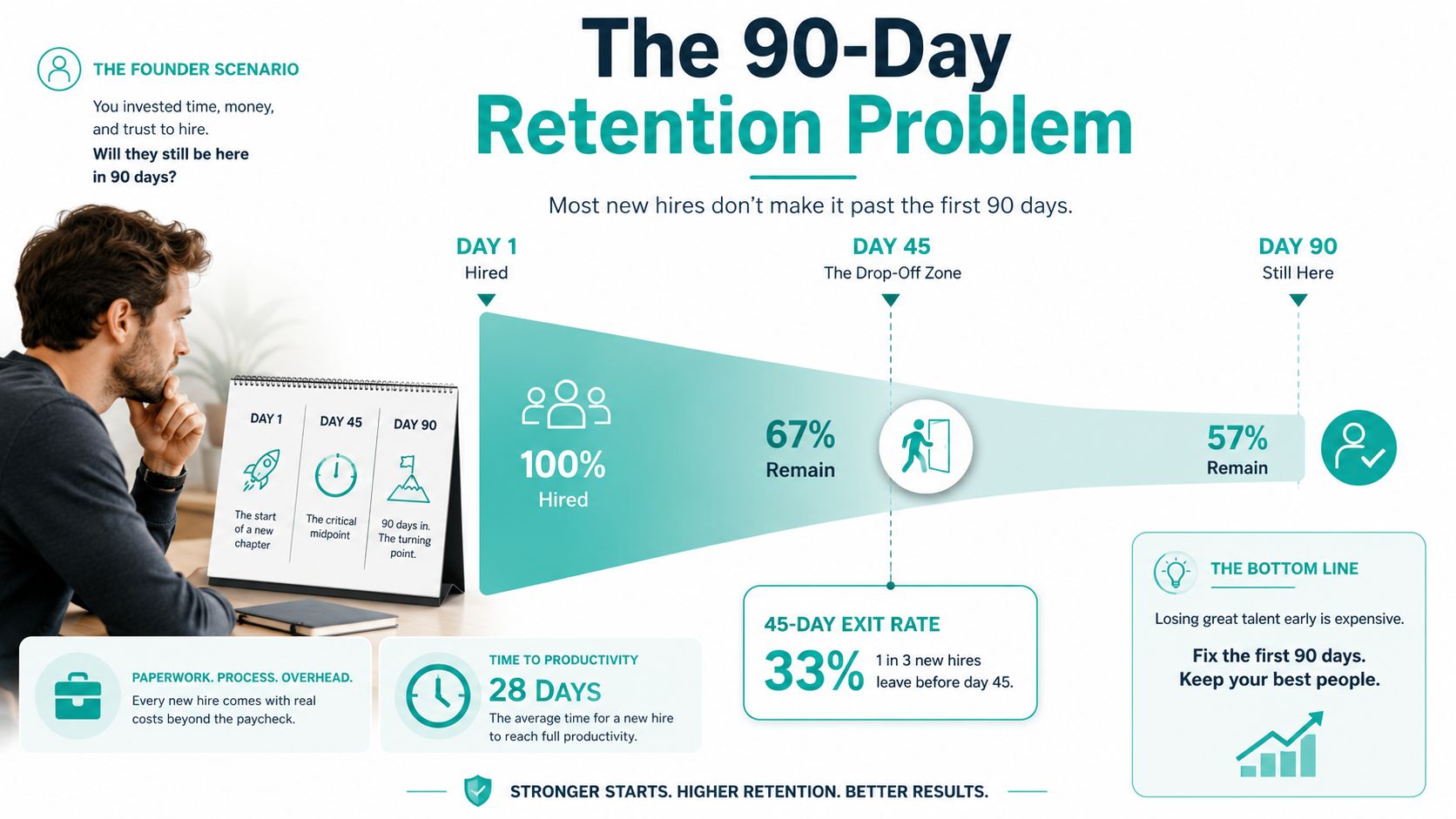
A one-day orientation can complete forms. It can't establish role clarity, relationships, working context, or confidence. Those develop through repeated interactions during the first several weeks, which is why onboarding should be managed as a 90-day operating system, not a day-one checklist.
Gallup reported that only 12% of employees strongly agree their organization does a great job onboarding new employees, making onboarding a management issue rather than a minor HR formality. Independent onboarding research summarized by Gallup also points to a fragile early window, with roughly 20% of employees leaving within their first 45 days and about 30% leaving within their first 90 days. Gallup's onboarding and retention guidance makes the practical implication clear. The first six weeks to three months deserve the most deliberate support.
For a seed or Series A company, an early departure disrupts more than a hiring plan. The team loses recruiting time, manager attention, institutional context, and momentum on the work that prompted the hire. I wouldn't build a business case around an invented replacement-cost multiplier. You don't need one. A failed hire consumes scarce cash and slows the people who are still delivering.
My rule: If the manager can't explain what success looks like at day 30, day 60, and day 90, the company hasn't finished hiring. It has only signed an offer.
Strong onboarding is associated with substantial retention gains. Organizations with strong programs have been linked to 82% higher new-hire retention, while employees with a great onboarding experience have been reported as 69% more likely to stay for three years, according to the onboarding benchmark summarized by FirstHR. SHRM separately reports that employees are 58% more likely to stay for three years after structured onboarding. SHRM's culture and onboarding guidance supports treating onboarding as a multi-week or multi-month process.
The framework I'd use is simple: pre-board before day one, set a 30/60/90 plan, build a role-specific ramp, assign clear owners, and measure the result. The following system gives a founder or hiring manager the operational steps to make onboarding new hires stick.
The week before someone starts should feel prepared, not improvised. Send the logistics email immediately after acceptance, covering payroll forms, equipment preferences, shipping address, benefits steps, and the practical details that otherwise consume the first morning. If you want a useful reference for the transition from accepted offer to start date, this guide to accepting a job offer gives candidates helpful context.
Two business days before the start date, send a personal note from the hiring manager. Attach a one-page organization map, a short list of day-one meetings, and a concise explanation of what the new hire will accomplish during the first week. Provision email, Slack, GitHub, Notion, the relevant analytics tools, and role-specific systems before the person logs in. A new employee shouldn't spend hour two filing IT tickets.
A tight agenda creates momentum without pretending a new hire can absorb the whole company in one sitting.
Block the new hire's calendar for the first five days. Leave room for questions, but don't leave empty hours that communicate indifference. At the same time, avoid filling every minute with presentations. The first day should remove friction and establish relationships, not create an information backlog.
A 30/60/90 plan should be a learning ramp, not a task dump. The plan needs to answer four questions for every phase: What should this person learn? What should they deliver? How will the manager recognize progress? Which resources reduce unnecessary searching?
Days 1 to 30 are for consuming context. The new hire reads the codebase, reviews product decisions, shadows customer calls, studies recent research, and fixes a small bug or copy-edits a specification. The success signal is comprehension. Can they explain the product, the customer, the team's decision process, and the constraints around their role?
Days 31 to 60 are for contribution. Assign one clearly scoped project with a named reviewer and a Friday demo. The project should be small enough to finish and meaningful enough to reveal how the person thinks, communicates, and responds to feedback. Don't hide behind “learn the system” for two months. Give the hire a safe way to produce visible work.
Days 61 to 90 are for leadership. Ask the person to propose a roadmap improvement, mentor a peer on something they now understand, run a meeting, or own a contained decision. Leadership at this stage doesn't mean managing people. It means showing independent judgment and making the team more effective.
The manager should hold a weekly 30-minute one-on-one with a standing agenda: progress, confusion, blockers, relationships, feedback, and the next meaningful decision. Add formal reviews at day 30, day 60, and day 90 using the same rubric: role fit, ramp velocity, and team integration.
Staged cognitive load matters. Cut meetings in week one. Add scope only after the hire demonstrates context. More information isn't the same as better onboarding.
| Phase | Focus | Sample Deliverables | Success Signal |
|---|---|---|---|
| Days 1 to 30 | Consume context | Codebase notes, customer-call observations, small bug fix, product or research review | Explains key systems, priorities, stakeholders, and constraints |
| Days 31 to 60 | Contribute | Scoped project, documented decisions, Friday demo | Delivers useful work with the expected review process |
| Days 61 to 90 | Lead | Roadmap proposal, team meeting, peer mentoring, or contained ownership | Makes sound decisions with less manager intervention |
Use the same structure for every phase: Goals, Key Results, Success Signals, and Resources. That format gives the employee a map and gives the manager an objective basis for support.
The same onboarding checklist can't serve every startup role. Engineering, product, and design hires need different evidence that they're gaining context and becoming productive. “Get up to speed” isn't a milestone. A working environment, a shipped starter ticket, a usable PRD, or a completed design flow is.
By day three, the engineer should have a functioning development environment, repository access, local setup documentation, and a clear person to contact when something fails. During week three, ship a scoped starter ticket, ideally with a reviewer who can explain both the technical standard and the product reason behind the work.
By day 90, the engineer should own a small feature or meaningful slice of a system. The manager should remove cognitive load in week one by limiting architecture meetings, assigning one repository path to study, and defining the review workflow. The ramp is on track when the engineer can make a change safely, explain its trade-offs, and identify the right stakeholders without constant routing.
Product managers need customer and business context before they need a roadmap mandate. During the first month, have the PM shadow customer calls, review the last six months of user research, study decision logs, and meet the people who support, sell, build, and use the product.
By week six, the PM should draft a small PRD with a clear problem, evidence, proposed approach, open questions, and success signal. Between days 61 and 90, the PM can own a contained slice of the roadmap. Don't ask for a grand strategy before the person understands the company's existing commitments and customer language.
Designers should begin with a style and product audit, then join paired critiques before taking on a full flow. A contained end-to-end experience by day 60 is a better ramp signal than a pile of disconnected mockups. By day 90, the designer should be able to explain how research, interaction decisions, visual standards, and engineering constraints shaped the work.
| Role | Day 1-30 Deliverable | Day 31-60 Deliverable | Day 61-90 Deliverable |
|---|---|---|---|
| Engineering | Working environment, system map, starter ticket | Scoped feature or technical project | Ownership of a small feature |
| Product | Customer-call notes, research synthesis, decision-log review | Small PRD and cross-functional review | Ownership of a roadmap slice |
| Design | Style audit, product walkthrough, paired critiques | Contained end-to-end flow | Iterated experience with clear rationale |
The manager's job is to sequence complexity. Remove unnecessary meetings, broad access requests, and unrelated training in week one. Add ownership only after the hire can describe the context behind the work.
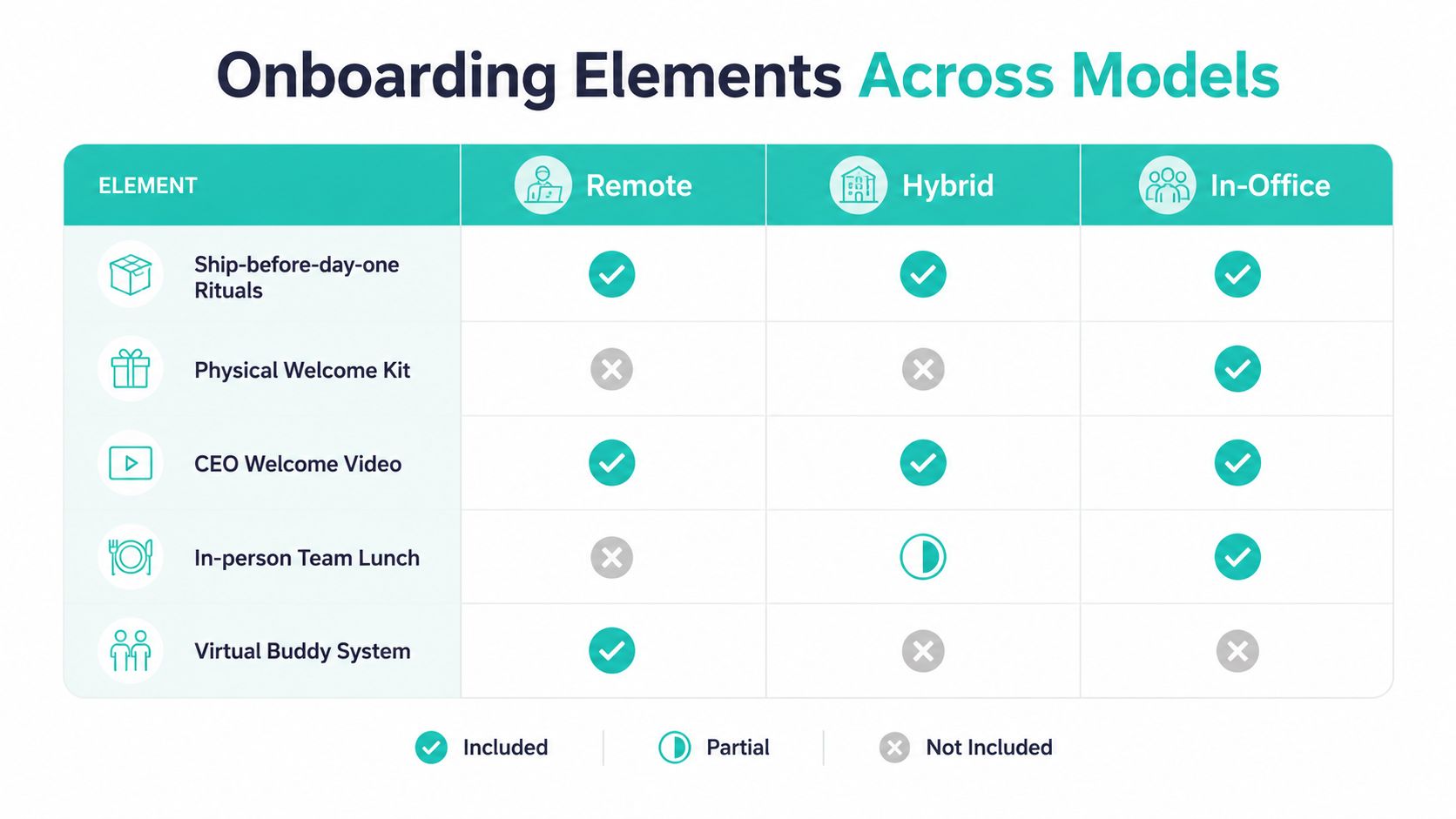
Remote onboarding often fails by copying office rituals into video calls. Hybrid onboarding commonly assumes proximity creates context on its own. In-office onboarding can also miss the mark when leaders mistake visibility for inclusion. Build the process around the work a new hire must understand, the relationships they must form, and the decisions they must eventually own.
The strongest onboarding elements work across locations. Ship the laptop, provision accounts, send a welcome note, and record an introduction from the CEO in every model. Protect the manager's one-on-one time as well. A recurring conversation creates space for questions, context, and early feedback. It should not become a rushed status update.
Informal hallway context needs a deliberate replacement. Remote hires need Slack introductions, a written team map, an async starter document, and a clear channel list. Hybrid hires need the same written foundation because office days do not guarantee that the right conversation happens at the right time. In-office hires benefit from it too, especially when decisions and explanations otherwise remain scattered across conversations.
Use async for durable context. Keep the org map, glossary, decision logs, team norms, access instructions, and first-week plan in one source of truth. Written material lets a new hire search, revisit, and ask better questions. It also prevents managers from repeating the same explanation across hires.
Use Zoom for interpretation. Manager one-on-ones, architecture discussions, customer-call debriefs, and early feedback conversations need live interaction. Keep the group small and send written notes afterward. A video call should create discussion, not deliver a one-way lecture.
Use in-person time for high-bandwidth learning. Pair programming, customer ride-alongs, and design critiques can justify travel for hybrid hires during the first month. These sessions expose tacit behaviors that documentation often misses, including how people challenge ideas, resolve ambiguity, and make trade-offs.
For remote hires, I would plan an intentional on-site opportunity during week two and again around month three when the role and budget support it. The purpose is relationship density, paired work, and a deliberate review of what the employee understands. Teams that need practical ideas for connection rituals can also use this resource to engage remote workers effectively across time and distance.
Onboarding falls between People Ops and the hiring manager when nobody owns the outcome. Use a RACI-style breakdown and publish it with the plan.
| Onboarding task | HR or People Ops | Hiring manager | Buddy | IT or Operations |
|---|---|---|---|---|
| Pre-boarding paperwork | Responsible | Consulted | Informed | Informed |
| Equipment and access | Accountable for process | Responsible for role access list | Informed | Responsible for provisioning |
| Week-one agenda | Consulted | Accountable and responsible | Consulted | Informed |
| Role goals and feedback | Informed | Accountable and responsible | Consulted | Informed |
| Cultural navigation | Informed | Consulted | Responsible | Informed |
| 30/60/90 reviews | Consulted | Accountable and responsible | Consulted | Informed |
If a new hire has two managers, appoint one as the single accountable manager. That person owns the plan, feedback cadence, performance signal, and escalation path. The second manager can define matrixed priorities, but cannot issue competing instructions without resolving the conflict directly.
Adapt the social design to the work model. Remote teams should give the buddy a standing question channel and make introductions in writing before relying on informal contact. Hybrid teams should use office days for paired work or relationship building, not leave the new hire to infer who matters from desk proximity. In-office teams should still document key decisions and include people who are absent. The manager remains responsible for resolving confusion and protecting the new hire's cognitive load.
For policies covering availability, communication, and location, document the operating rules instead of relying on assumptions. Teams can use remote work policy guidance to make expectations visible before a new hire has to guess.
A new hire saying “I feel good” matters, but sentiment alone won't show whether the system is working. Track the operational path from access to contribution, then combine the numbers with direct feedback.
Start with time to productivity. Define a role-specific event: shipping safe code, completing a customer discovery cycle, delivering a tested interface, or making an accepted product decision. Measure the median number of days until that event, then compare roles and cohorts rather than forcing every job into the same standard.
Track the following:
| Metric | Suggested threshold | Action if missed |
|---|---|---|
| 90-day retention | Above 90% | Review manager, role, cohort, and early-exit feedback |
| Meaningful manager check-ins | At least three during the first month | Reschedule immediately and audit calendar ownership |
| Critical access | No critical blocker on day one | Escalate provisioning and fix the access checklist |
| Passive training load | No more than 20% of the first two weeks | Replace modules with guided work and role context |
These thresholds are operating guardrails, not universal laws. Segment the dashboard by role, location, manager, and hiring cohort. If product hires stall while engineering hires move, the issue may sit in customer context or roadmap access. If one manager's cohort struggles, inspect expectations and feedback before changing the whole program.
Use quality-of-hire metrics to connect onboarding signals with longer-term hiring decisions. Publish a simple monthly dashboard, annotate changes in hiring or product direction, and test one onboarding improvement at a time. The purpose is to trigger support, not grade probationary employees.
A fast-growing company needs onboarding that stays consistent while each new hire still feels seen. The goal is structure, not a script. Treat the process as a 90-day retention and time-to-productivity system, with clear owners, useful context, and room for role-specific judgment.
Keep human attention on the moments that build trust:
Document the standard process and make exceptions visible. If a remote engineer needs a different access path or a product hire needs additional customer exposure, record the reason and owner. Informal workarounds become hidden policy when nobody captures them.
At higher hiring volume, assign one directly responsible owner for the onboarding program. Maintain a source of truth for templates, owners, role plans, access requirements, and review dates. Review program quality quarterly, but audit a role's 90-day plan whenever the job changes.
Hiring managers need onboarding too. Give each manager a short briefing on the plan, expected check-ins, role-specific outcomes, and escalation paths before their new hire starts. This prevents every team from inventing its own standard and makes quality easier to inspect across departments.
Cohorts can make orientation and peer connection more efficient. They shouldn't replace individual ramps. Two engineers may share a company introduction, but their starter tickets, repository paths, reviewers, and success signals still need to match their work.
As headcount grows faster than People Ops can coordinate manually, use a queue with launch dates, owners, blockers, and overdue steps. Review the queue regularly and sample completed plans across teams. For engineering, product, and design hires, remove unnecessary tools, meetings, and reading from the first weeks so cognitive load stays focused on the work that proves readiness.
A founder hiring quickly should be able to open one plan and see what the employee needs, who owns each step, what the person is expected to learn, and whether the ramp is working. If that information lives in scattered messages, the company is relying on memory. Memory won't scale.
Underdog.io connects startups with curated tech candidates across engineering, product, design, data, and other functions, giving founders a focused hiring marketplace while they build a structured 90-day onboarding system. Visit Underdog.io to explore a more targeted way to build the next team your onboarding process needs.