Maya had just closed a big round, and the relief lasted about a day. Then her lead platform engineer, Devon, got a call from a competitor, and she had to decide fast how to keep him engaged without blowing up the cap table or handing out shares she didn't really want to hand out yet.
That's the tension behind phantom equity plans. They give a founder a way to say, “If the company wins, you win,” while keeping the legal and ownership structure cleaner than real stock.
Maya's problem is common in startups that have momentum but still feel fragile. She wants Devon to feel the upside if the company sells, gets recapitalized, or clears a meaningful milestone like a new financing round. She also knows she can't keep issuing options forever if her investor is already watching the pool, the authorized shares, and every new line added to the cap table.
That is where phantom equity becomes a practical workaround. The employee gets economic exposure that looks and feels like ownership, but the company doesn't add a shareholder. The idea lines up with how the U.S. Bureau of Labor Statistics describes phantom stock, employees get many of the benefits of stock ownership without receiving shares, and it's been used long enough that an SEC filing showed a phantom stock plan adopted in 1994 and still active decades later in 2021 (SEC filing).
The first is option pool pressure. If the board and investors are already policing the pool, another option grant may be politically hard even if the hire is essential.
The second is authorized share friction. A company can run out of room on paper before it runs out of people to reward. That's awkward for a founder who wants to keep hiring without renegotiating the equity map every quarter.
The third is governance complexity. New shareholders can create consent issues, information rights questions, and more legal cleanup at the worst possible time. Phantom equity sidesteps that by giving Devon a cash claim instead of a new ownership stake.
A useful way to think about Maya's choice is this. She doesn't need another true owner yet. She needs a compensation structure that can behave like upside without turning Devon into a cap-table line item.
Practical rule: phantom equity is usually a retention design, not a ownership transfer. That distinction matters before anyone starts comparing it to stock.
A phantom equity plan is a contract, not stock. It promises a future cash payment tied to company value, but it doesn't issue real shares, voting rights, or a board seat. It's a share-shaped bonus that tracks the company's upside, but the employee gets dollars instead of paper.
That's why the employee is not an owner. Once the trigger happens, the employee usually stands as a general unsecured creditor for the promised payout, not as a shareholder with direct rights in the company. The label changes, too. People often say phantom stock, phantom equity, synthetic equity, or virtual stock loosely, but the economic point is the same, the payout is contractual and cash-based.
A simple way to separate the moving parts is to look for four design building blocks:
If any one of those is vague, the employee and the company may end up arguing about expectations later. Clear drafting matters because phantom equity is meant to be familiar enough for an employee to understand, but precise enough for lawyers, payroll, and finance to administer.
A real shareholder can usually point to ownership, voting rights, and, in some cases, dividend or consent rights. A phantom equity holder gets none of that. The upside can feel equity-like, but the mechanics are closer to a deferred bonus plan with a value formula attached.
That makes phantom equity especially useful for companies that want incentive alignment without changing control. It's also why many founders use it for key employees who care about the outcome, but don't need the full legal package that comes with actual stock.
For a deeper comparison of vesting mechanics, the structure of grants in startup compensation is also laid out in this equity vesting schedule guide. The same logic matters here because the timing of when value is earned often matters as much as the value itself.

If you're working in a market with different entity structures, a practical resource is phantom options for Israeli companies from RNC Group. The mechanics are still centered on a contractual value-linked payout, but local implementation can change the drafting details.
The three mechanics work best when you read them in order. First comes valuation, then vesting, then the trigger that turns the paper promise into cash.
Most private companies anchor phantom unit value to a recent fair market value or a formula based on enterprise value. A practical payout formula, like the one commonly used in startup guidance, is:
Payout = Phantom Equity % × Vested % × (Current Value − Baseline Value)
That means the employee's gain depends on both how much was granted and how much the company grew above the starting line. If Devon holds 10,000 units, each with a baseline value of $1.00, and the company sells for $50 million with 5 million fully diluted shares, the per-share value at exit is $10.00. The appreciation above the baseline is $9.00 per vested unit, so if all 10,000 units are vested, the payout is $90,000 before tax.
The standard pattern is a four-year schedule with a one-year cliff, then monthly or quarterly vesting after that. The cliff prevents short-tenure awards from paying out too early, and the ongoing vesting keeps the incentive tied to continued service.
Some plans add performance conditions instead of, or on top of, time-based vesting. Revenue or ARR milestones can work as gating events, especially when the company wants the award to track business outcomes rather than just time in seat. That can make sense for sales leaders, operators, or executives whose work maps cleanly to measurable growth.
A single trigger usually means a change of control alone starts the payout. A dual trigger ties payment to a change of control plus a termination without cause within a defined period, often 12 months, so the employee doesn't lose the benefit just because the company was sold.
The payment timing matters for tax and admin reasons. A short-term deferral window of 2½ months after the end of the tax year in which the right vests is a common 409A-safe structure for payout timing (short-term deferral analysis). If the payment lands inside that window, the company has a simpler path for keeping the plan inside deferred-compensation rules.
| Input | Value | Result |
|---|---|---|
| Phantom units | 10,000 | Vested payout basis |
| Baseline value per unit | $1.00 | Starting point |
| Exit value per unit | $10.00 | Appreciation of $9.00 per unit |
| Fully vested | Yes | Full payout earned |
| Total pre-tax payout | $90,000 |
Phantom equity can look clean on a slide and complicated on a tax return. The biggest issues sit in three places, Section 409A, employee taxation, and the company's accounting treatment.
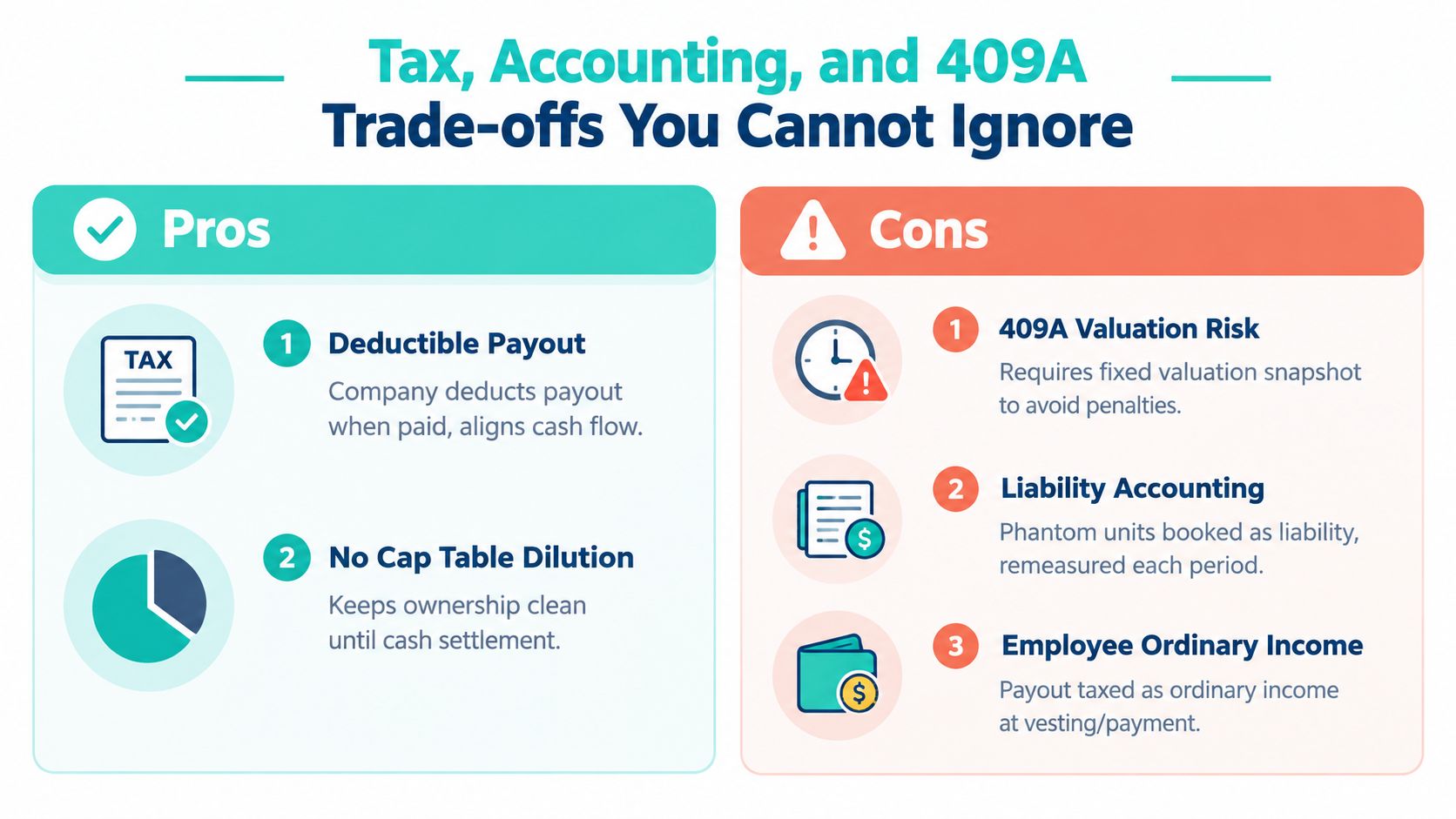
The IRS treats phantom stock as nonqualified deferred compensation, not actual stock. That means the employee is generally taxed as ordinary income when the payout is made, and withholding usually runs through payroll as W-2 wages, not capital gains treatment (IRS guidance). That is the trade-off many generic explainers skip.
If the plan is designed properly, tax deferral continues until the cash is paid, and the employer generally gets a corresponding deduction at payout. But the employee usually gives up the tax advantages that can come with real equity, including capital-gains treatment and the planning flexibility that comes with stock ownership.
From an accounting standpoint, phantom stock is often treated as a liability award when cash settlement is expected. The company has to remeasure the award over time, and compensation expense can move up or down as the business valuation changes. That means the expense is not a one-time grant-date number, it can swing as vesting progresses and as the company's value changes.
Phantom equity can be easy to promise and harder to carry. If the valuation changes, the expense can change with it.
That is why periodic valuation matters. Private companies often rely on formula-based approaches, EBITDA multiples, revenue multiples, or third-party appraisals, because the eventual payout depends on a notional value at the trigger or settlement date (NCEO overview). For a broader overview of how equity pay structures show up in startup compensation, see private company stock options guidance.
They gain predictable cash, a structure that can be easier to explain than exercise math, and no need to address 83(b) elections or AMT planning. They also avoid shareholder paperwork and cap-table complexity.
They lose the upside of real ownership. No voting rights. No direct shares. No QSBS treatment. No step-up in basis from holding stock. That's why phantom equity can be a smart retention device, but a poor substitute when a candidate really wants actual ownership.
For companies building more formal deferred-compensation programs, Allied Tax Advisors executive compensation is a useful reference point for thinking through timing, documentation, and payout design with tax in mind.
The easiest way to compare these tools is to ask what the recipient gets. Phantom equity gives cash tied to value, stock options give a right to buy shares, and RSUs give actual shares at vesting. That single difference drives most of the tax, dilution, and governance trade-offs.
| Feature | Phantom Equity | ISO | NQSO | RSU |
|---|---|---|---|---|
| Ownership rights | None | Yes, after exercise | Yes, after exercise | Yes, at vesting |
| Dilution to founders | None until cash payout | Yes | Yes | Yes |
| Cash required from employee | No exercise cost | Yes, at exercise | Yes, at exercise | No |
| Payout form | Cash | Shares | Shares | Shares |
| Tax at grant | Usually none | Usually none | Usually none | Usually none |
| Tax at payout or vesting | Ordinary income | Potential capital-gains treatment if rules are met | Ordinary income, often plus payroll taxes | Ordinary income at vesting |
| QSBS eligibility | No | Potentially, if holding and other rules are met | No | No |
| Governance complexity | Lower | Higher | Higher | Higher |
| Best fit | Retention without ownership | Founder-style upside | Broad employee options | Mature-company retention |
Phantom equity looks like equity from a distance, but it pays in cash and doesn't create a shareholder. That keeps the cap table clean, but it also means the employee doesn't get the full ownership toolkit.
Options sit on the other side of the line. They create a real pathway to ownership, but they also require exercise cost and usually come with more tax planning. RSUs are simpler in one way because the employee gets actual shares automatically at vesting, but that simplicity comes with ordinary-income taxation at vesting and real dilution for the company.
If the company wants ownership alignment, real equity usually wins. If the company wants cash-based retention without dilution, phantom equity is often cleaner. If the company is already mature and wants straightforward employee ownership, RSUs can make sense where the share issuance and tax timing fit the business.
For a broader startup equity primer, equity compensation for startups helps frame how these pieces fit into a broader offer package.
A phantom plan usually starts with board approval and, where needed, shareholder approval or a waiver. From there, the company needs one document to do the heavy lifting. It should spell out the purpose, who can participate, grant size, valuation method, vesting, payout trigger, forfeiture rules, and the payment window needed to stay within deferred-compensation rules.
A founder can picture the document as the rulebook for a cash bonus that tracks equity value. The company is not handing over shares, but it is promising a cash payment that rises or falls with the business.
Here is the kind of language counsel often tightens:
Grant clause. The company grants the participant [number] phantom units effective [grant date], each unit initially valued at [fair market value per unit at grant].
Vesting clause. The units vest over four years, with a one-year cliff, and the remainder vests monthly thereafter, subject to continued service.
Payout clause. Upon a permitted payment event, the participant receives cash equal to the number of vested units multiplied by the change in enterprise value per unit, less any required withholding.
Timing clause. Payment will be made within the short-term deferral period permitted under Section 409A, including the 2½-month window after the end of the tax year in which payment becomes due.
Those clauses work only if the definitions behind them are tight. If the plan says a payment event exists but never defines it, people will argue later about what counts. If the valuation reference is vague, the payout formula turns fuzzy too. Good-leaver and bad-leaver treatment should be written out clearly so a departing employee knows whether vested rights survive termination.
If you are managing this alongside hiring or compensation planning, a structured hiring marketplace such as Underdog.io can help founders compare cash, equity, and candidate expectations in startup offers. It is a practical reminder that phantom equity sits inside a wider comp package, not apart from it.
A founder usually reaches for phantom equity when the company wants retention without adding real owners to the cap table. It fits non-founding employees, some foreign workers where actual equity is harder to grant, and teams that need upside tied to company value without changing governance. After an acquisition, it can also reward the remaining team without reopening the ownership structure.
The structure works like a cash bonus with equity-shaped upside. That makes it useful when the business wants alignment, but not voting rights, board influence, or a true ownership stake.
It is a weaker choice when the person expects actual equity. If a candidate wants voting rights, long-term upside, or founder-style influence, phantom equity can feel like a substitute rather than the genuine article. It also breaks down when the company cannot support a defensible valuation process, because the payout formula then rests on a number no one trusts.

The warning signs on the employee side are easy to spot once you know them. If the payout trigger is fuzzy, if good-leaver and bad-leaver treatment is missing, if the valuation is not defensible, or if the payment window exceeds 2½ months, the plan deserves a hard look before anyone signs.
If you are comparing phantom equity with options, RSUs, or a plain cash bonus, the core question is whether the company wants a bonus that behaves like equity, or actual ownership.