If you're a software developer, you know the career path isn't a straight line anymore. It's a sprawling map of exciting, specialized routes, and figuring out which one to take can feel overwhelming. This guide is your compass for navigating the opportunities in 2026 and beyond.
The world of software development is more complex and full of potential than ever. The global developer population is expected to hit 28.7 million by 2025, but don't let that number fool you. The demand for specialized talent, especially within fast-growing startups, is red-hot.
We're not just talking about a small bump in hiring. Projections show a massive 17% growth in software developer jobs between 2023 and 2033. That translates to over 327,900 new positions, far outpacing the average for other professions. This surge is driven by an insatiable need for experts in AI, cloud, and cybersecurity.
So, what does this boom mean for your career? It means that just being a good coder isn't enough anymore. You need a strategy. This guide will give you a high-level view of the most valuable specializations and the skills that command higher salaries.
The key to a successful software career in 2026 isn't just about being a good coder; it's about being a strategic problem-solver who understands where the industry is heading.
We'll break down the different paths available to help you answer one critical question: What should I focus on right now to advance my software career?
Here’s a look at what we’ll cover:
By the end, you'll have a clear framework for your next move. If you're ready to jump right into the job search, our guide on how to get a job in software engineering is a great place to start.
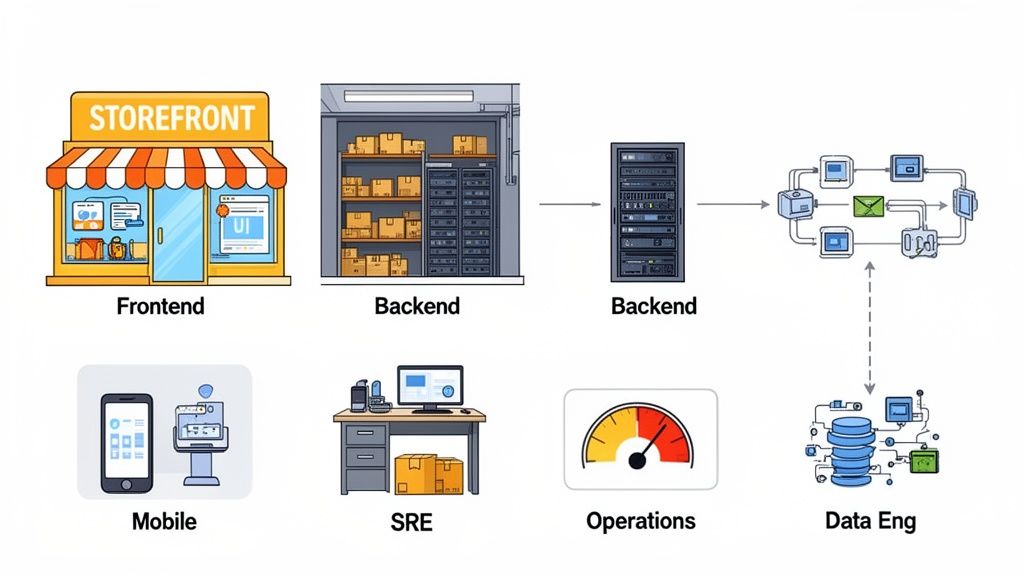
The world of software development is filled with jargon. Job titles like "Backend Engineer," "Frontend Developer," or "SRE" get thrown around constantly, but what do these people actually do all day? Getting a handle on these roles is your first step toward finding a path that genuinely clicks with your skills and passions.
Let's break it down with a simple analogy: building a modern e-commerce store. A single online shop needs a whole crew of specialists to go from an idea to a real, revenue-generating business. Each person owns a critical piece of the puzzle, and their collaboration is what brings the entire project to life.
Frontend developers are the architects and interior designers of our e-commerce site. They build everything a customer sees and touches—the digital “storefront.” Their goal is to make the site look great, feel intuitive, and work flawlessly whether you're on a laptop or a phone.
A typical day for a frontend developer involves turning static design mockups from tools like Figma into living, breathing code. They are obsessed with the user experience (UX) and user interface (UI), ensuring every button is satisfying to click, every menu is easy to navigate, and the whole experience is smooth and fast.
Core responsibilities include:
If the frontend is the public-facing storefront, the backend is the entire back-of-house operation: the warehouse, the inventory system, and the secure payment terminal. Backend developers build and run the server-side logic that makes the whole business function. It's the engine customers never see but completely depend on.
When someone clicks "Buy Now," it's a backend developer's code that securely processes the payment, tells the warehouse to ship an item, and updates the inventory count. They manage databases, secure user accounts, and build the APIs (Application Programming Interfaces) that let the frontend talk to the server.
You'll find them working with languages like Python (often with Django or Flask), Go, Node.js, and Java. Their days are spent writing business logic, architecting database schemas, and making sure the core application is secure, scalable, and reliable.
Backend development is the invisible backbone of any application. It’s where the data lives, the rules are enforced, and the real business logic happens. A strong backend makes a seamless frontend experience possible.
The full-stack developer is the "general contractor" for our e-commerce project. They have the skills to work on both the customer-facing frontend and the operational backend. This versatility makes them huge assets, especially at startups where teams are lean and everyone needs to be flexible.
A full-stack engineer might spend their morning tweaking a button's animation with CSS and their afternoon optimizing a slow database query. They have a holistic view of the entire technology stack, which allows them to build entire features from the ground up and troubleshoot problems anywhere in the system.
As you get deeper into the industry, the roles become even more specialized. To get a better sense of the nuances, it's helpful to understand the academic and practical foundations, like the differences between Computer Science vs. Software Engineering.
When you’re trying to land a great software developer role, your resume and portfolio are your one-two punch. Think of your resume as the hook that gets a hiring manager to stop scrolling and pay attention. Your portfolio is the follow-through that proves you’ve got the skills to back it up. Getting both right isn't just a good idea—it's essential for getting noticed by high-growth startups.
Your application materials are your first impression. Knowing how to put together a compelling software engineer resume can be the single most important factor in whether you get a closer look or get passed over.
Stop listing your job duties. Seriously. Startup hiring managers couldn't care less that you "were responsible for the user authentication system." They need to know what you did with it. Did you make it faster? More secure? Did you cut down on user friction? That's what matters.
A simple way to do this is by thinking in terms of the STAR method (Situation, Task, Action, Result). It’s a formula that forces you to focus on the outcome.
For instance, instead of a boring bullet point like:
Reframe it to show your impact:
This tiny shift turns your resume from a passive list of things you were told to do into a highlight reel of problems you've solved. Every single bullet point should tell a story of how you created real, measurable value.
A great tech resume isn't about what you did; it's about what you achieved. Every bullet point should answer the question, "So what?" by highlighting a specific, quantifiable result. For more detailed guidance, check out our in-depth article on how to write a tech resume that gets results.
Your portfolio is where you prove you can actually build things. It's your chance to show you’re a problem-solver, not just a list of skills on a resume. While basic projects like to-do apps and calculators are great for learning the ropes, they won't make you stand out. Hiring managers have seen hundreds of them.
The portfolios that really catch an employer's eye are the ones built around solving a genuine problem—even a small, niche one.
Actionable Portfolio Project Ideas
BeautifulSoup and requests to scrape the data and consolidate it into a single CSV file. This shows you have an eye for efficiency, which is gold to a startup.Whatever you build, how you present it is just as important as the code itself. A well-documented GitHub repository with a clear README.md is non-negotiable. Explain what the project is, why you built it, the tech you used, and how someone else can run it. This level of professionalism signals that you write clean, maintainable code—a quality every high-growth startup is desperate to find.
A software developer's career path isn't a straight line up a corporate ladder. It’s an evolution. You start by focusing on writing clean code, but as you grow, your attention shifts to architecting robust systems and, eventually, to mentoring the next generation of engineers.
Think of it less as climbing and more as expanding your sphere of influence. You move from being an individual contributor who executes well-defined tasks to becoming a technical leader who shapes the direction of your team, your product, and even the entire organization.
This chart lays out the typical progression, showing how your focus naturally shifts from code to systems and finally to people and strategy.
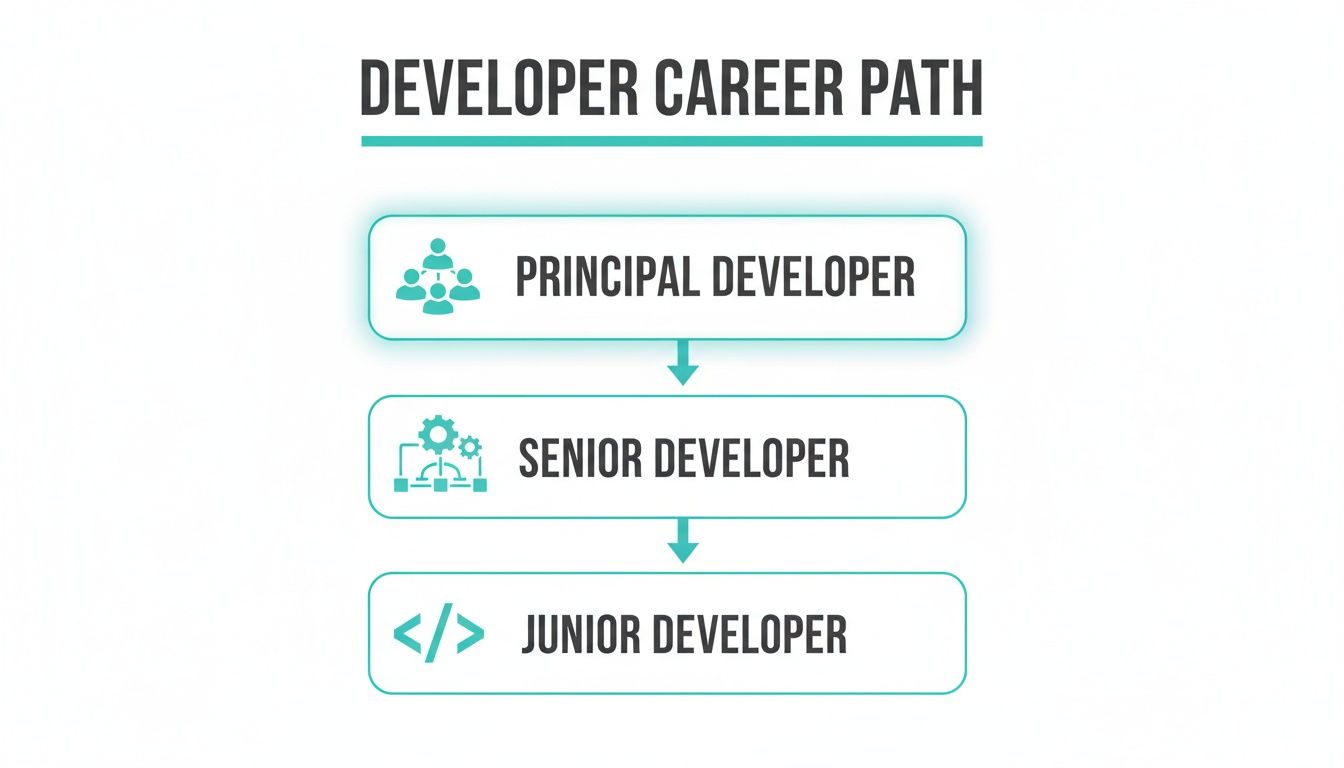
As you can see, the journey transforms your primary output from lines of code into well-designed systems and a more effective engineering team.
Every step up the engineering ladder brings a fundamental change to your day-to-day work. Understanding these shifts is crucial if you want to prepare for that next role and nail the interview.
The table below breaks down the typical software engineer career path, outlining how your focus and responsibilities change as you gain experience.
Knowing where you are and where you want to go helps you focus on developing the right skills to make the jump to the next level.
For engineers who love the technical weeds and want to keep building, the individual contributor (IC) track doesn't dead-end at "Senior." It opens up into highly strategic roles that focus on deep technical leadership across the entire company.
Salary is just one part of the equation. To properly evaluate any offer—especially from a startup—you need to look at total compensation. This is the full package: base salary, performance bonuses, and that all-important equity.
Despite some noise in the market, developer earning power is still incredibly strong. Data shows that 36.4% of full-time developers earn between $50,001 and $200,000 annually. Another 7.9% pull in over $200,000.
While 44.87% of developers switch jobs for a bigger paycheck, a nearly identical number (43.91%) are hunting for better advancement opportunities. This powerful combination of high pay and rapid growth is exactly what high-potential startups offer.
To get a more granular look at what you can expect to earn, check out our guide on how much money software engineers make for benchmarks based on role, experience, and location.
Your compensation package will usually be broken down into these three core components:
There’s a reason so many top engineers trade the predictability of a corporate giant for the controlled chaos of a high-growth startup. And it’s not just about the casual dress code or the fully-stocked snack kitchen. The real draw is the fundamental nature of the work itself, which puts developers at a crossroads between two very different career paths.
At a massive company, your work is often a small, specialized part of a very large machine. Progress can feel slow, bogged down by layers of management and rigid processes. Startups, on the other hand, run on urgency and directness. The code you push on Tuesday could be a core feature that defines the product by Friday.
This kind of environment gives you a high degree of autonomy and ownership. Engineers are frequently responsible for entire features, from the initial idea all the way to deployment. You’re not just executing a task; you’re making decisions that have an immediate, visible impact on the business. For developers who want to see their work truly matter, that’s a powerful motivator.
One of the biggest differences in startup compensation is equity. Instead of just a salary, startups give you a piece of the company, usually as stock options. This isn't just a bonus; it’s the right to buy company shares later at a predetermined price, known as the "strike price."
Think of it like getting in on the ground floor. If you join an early-stage company, your strike price might be incredibly low. If that company takes off and its value skyrockets, you can buy your shares at that original low price and sell them for a massive profit. This potential for a life-changing financial outcome is a primary reason top talent bets on startups.
Equity is more than just a financial instrument; it's a mechanism for alignment. When you own a piece of the company, you are no longer just an employee—you're an owner. Your incentives are directly aligned with the company's success.
But this potential reward comes with a catch. Equity isn't handed over all at once. It’s earned over time through a vesting schedule, which is just a timeline for earning your shares. A typical schedule is four years with a one-year "cliff." This means you don’t get any shares for your first year, but on your one-year anniversary, 25% of your grant vests instantly. After that, you’ll earn a small portion every month until you’re fully vested after four years.
Joining a startup is a calculated risk. A great way to measure that risk is to understand the company's funding stage, which tells you a lot about its financial health, maturity, and growth trajectory.
Don't be surprised if a startup interview feels completely different from a corporate one. While Big Tech interviews can lean heavily on abstract whiteboard algorithms, startup interviews are all about practical problem-solving and cultural fit. They want to see how you think, not just what you've memorized.
You’ll face questions directly tied to the company's product or current technical hurdles. Instead of being asked to reverse a binary tree, you're more likely to hear questions like:
This approach is designed to see if you can hit the ground running and add value from day one. They’re hiring you to solve their problems, so showing a pragmatic, product-focused mindset is the key to success.
You've got the lay of the land for your software developer career. You understand the roles, you get what startups need, but now you have to actually find the right company. Sending out application after application can feel like shouting into a void—a painfully common experience known as the “resume black hole.”
But there’s a much smarter way to connect with high-growth companies. Instead of you chasing jobs, what if the best startup opportunities came directly to you? This is the whole idea behind curated hiring platforms, which flip the old-school job search on its head.
Platforms like Underdog.io are built to cut through the noise and connect you with roles that are a genuine fit. The process couldn't be simpler: instead of tweaking your resume for dozens of different applications, you create one comprehensive, confidential profile.
That single profile is your ticket to hundreds of vetted companies actively hiring for roles that match your skills and career goals. The upsides to this approach are huge:
The most powerful shift in a job search happens when you move from being just another applicant to being a sought-after candidate. A curated platform makes you someone that top companies compete for, not just one more resume in a stack.
What really makes this model work is the human touch. Sure, algorithms can match keywords on a resume, but they almost always miss the subtle details that make a great career move. Human-powered matching connects you with opportunities based on a much deeper understanding of your experience, your ambitions, and what a specific company truly needs.
This means you get intros to roles that don't just line up with your tech stack, but also with the kind of impact you want to make. The goal is to spark meaningful connections that lead to long-term success—helping you finally stop searching and start being discovered by your next great team.
So, you're navigating the wild world of developer careers. It’s a journey filled with tough questions and conflicting advice. Let's cut through the noise and tackle a few common dilemmas with some straight, actionable answers.
There’s no magic number here, but a strategic move every 2-4 years can seriously accelerate your growth, both in skills and salary. This is especially true early on in your career.
Each new company throws you into a different codebase, a new team dynamic, and fresh technical challenges. For example, moving from a startup using Python/Django to one using Go and microservices can dramatically broaden your backend expertise.
But hold on—don’t start polishing your resume every year. Hopping too frequently is a classic red flag for hiring managers. You need to show that you can stick around to see important projects through. The sweet spot is moving for a substantial new challenge or a significant learning opportunity, not just a minor pay bump.
The short answer? Not anymore. While a CS degree gives you a great theoretical grounding, the tech world, and startups in particular, care way more about what you can do.
Many of the best engineers I’ve worked with are self-taught or came out of an intensive bootcamp. What really gets you hired is a killer portfolio of real-world projects and a rock-solid grasp of fundamentals like data structures and algorithms. Your ability to solve problems is what matters.
In modern software development, your GitHub profile speaks louder than your diploma. A portfolio that proves you can build, solve problems, and write clean code is the most important credential you can have.
Startup interviews are a different beast. They're less about abstract brain teasers and more about your practical ability to jump in and start contributing to their specific product. They want to see how you think, not just what you know.
To knock it out of the park, focus on these areas:
The most widely traveled paths in software development fall into a few distinct specializations. Frontend development focuses on everything users see and interact with — building interfaces using frameworks like React, Vue, or Angular. Backend development covers the server-side logic, databases, and APIs that power applications, typically using languages like Python, Go, Node.js, or Java. Full-stack development spans both layers, making those engineers especially valuable at startups where team sizes are lean. Beyond those three, mobile development (iOS and Android), site reliability engineering, and data engineering are each strong and growing specializations with their own career ladders and compensation ranges.
The typical path from junior to senior takes somewhere between four and six years, though the timeline varies considerably based on the environment you work in and the scope of problems you're solving. Junior engineers generally spend their first two years learning the codebase, writing clean code for well-defined features, and absorbing team standards. Mid-level engineers, with roughly two to four years of experience, take on full feature ownership with minimal oversight. Reaching senior level — where the primary focus shifts to system design, architecture decisions, and mentoring — usually requires four or more years of hands-on experience. Engineers who join high-growth startups often accelerate this progression because they're exposed to more complex problems, more ownership, and more responsibility earlier in their careers.
No — a computer science degree is no longer a prerequisite at most companies, and certainly not at the majority of high-growth startups. What hiring managers consistently prioritize is a strong portfolio of real-world projects, a solid grasp of fundamentals like data structures and algorithms, and demonstrated ability to solve practical engineering problems. Many working engineers are self-taught or came through intensive bootcamp programs. A well-maintained GitHub profile with meaningful projects, open-source contributions, and clear documentation carries more weight in most startup hiring decisions than a diploma alone.
Compensation varies considerably based on experience level, specialization, location, and whether you're joining a startup or an established enterprise company. Data from the industry shows that 36.4% of full-time developers earn between $50,000 and $200,000 annually, with another 7.9% earning above $200,000. Junior developers typically enter the market in the $70,000–$110,000 range depending on geography, while senior engineers at well-funded startups in major tech hubs can command base salaries well above $150,000, often supplemented by equity. It's important to evaluate total compensation — base salary, bonus, and equity — rather than focusing on base pay alone, especially at startups where equity can become the most valuable component of your package over time.
Equity is an ownership stake in the company, typically granted as stock options — the right to purchase shares at a fixed price (the strike price) set when your grant is issued. If the company grows and its valuation rises significantly, you can buy shares at that original low price and realize a substantial financial gain when the company goes public or is acquired. Equity is usually earned through a vesting schedule, most commonly four years with a one-year cliff, meaning you earn no shares in your first year but receive 25% of your grant on your one-year anniversary, with the remainder vesting monthly over the following three years. For software developers who join early-stage startups, equity can become life-changing in outcome — but it also carries risk, since the majority of startups do not reach a liquidity event. Understanding what percentage of the company your grant represents, not just the raw number of options, is essential to evaluating any startup offer.
Big tech companies like Google, Meta, and Amazon have historically relied on heavily structured interview loops with abstract algorithmic and data-structure problems, often disconnected from day-to-day engineering work. Startup interviews tend to be more practical and product-focused. Rather than asking you to solve abstract puzzles, startup hiring managers want to understand how you think through real problems — they might ask you to design a notification system relevant to their product, walk through a past project and defend your architectural decisions, or diagnose a performance issue in a realistic scenario. Showing genuine curiosity about the product, asking thoughtful questions, and demonstrating that you can hit the ground running and make an immediate impact on their specific codebase matters far more in a startup interview than having memorized algorithm patterns.
Both are senior individual contributor roles, but they operate at different scopes. A senior engineer typically focuses on the health and technical direction of a single team — designing systems, mentoring junior and mid-level engineers, and solving complex problems within their immediate area. A staff engineer operates across teams and has a broader organizational mandate. They tackle cross-cutting technical challenges that no single team can own alone, influence architecture decisions that affect multiple product areas, and often set technical direction for the engineering organization as a whole. The step from senior to staff is one of the most significant in a software career because it requires shifting from deep individual execution toward broader technical leadership, influence, and communication across the company.
On a traditional job board, you are the applicant — you browse listings, tailor your resume repeatedly, and submit applications into a process where you have little visibility or leverage. A curated hiring platform like Underdog.io inverts that model entirely. You build one comprehensive, confidential profile that represents your skills, experience, and career goals, and then vetted startups reach out to you directly with role introductions. This approach is more efficient because you eliminate the time spent on mass applications, and it creates higher-quality conversations because every company that contacts you has already reviewed your background and expressed genuine interest. For software developers who are passively exploring rather than actively job hunting, it is particularly valuable because your current employer never knows you're on the market unless you approve an introduction.
The highest demand in 2026 is concentrated around three core areas: artificial intelligence and machine learning integration (building products that use LLMs, fine-tuning models, and working with AI APIs), cloud infrastructure and DevOps (deep experience with AWS, GCP, or Azure, combined with infrastructure-as-code tools like Terraform), and cybersecurity engineering (secure software design, vulnerability management, and compliance). Within application development, strong knowledge of modern JavaScript frameworks — particularly React and Next.js — combined with backend proficiency in Python, Go, or Rust continues to be highly valued. Beyond specific technologies, the ability to work effectively across a distributed, async team and to communicate technical decisions clearly to non-engineers has become an increasingly important differentiator, especially at startups where engineering and product teams collaborate closely.
Ready to find your next role at a high-growth startup? At Underdog.io, we flip the job search on its head. Create one confidential profile, and let vetted companies apply to you. Stop searching and start getting discovered at https://underdog.io.