You're probably looking at Canada from one of two positions.
Either you're already an engineer in Canada and you're trying to figure out whether a local move still makes sense, or you're outside the country and Canada looks appealing but messy. Good cities, solid employers, stable immigration pathways, and a reasonable quality of life all pull you in. Then the confusion starts. Which city is worth targeting? What does a Canadian resume need to look like? Should you chase a domestic role first, or hold out for a remote U.S. company that hires in Canada?
A software engineering job in Canada isn't one market. It's several overlapping ones. There's the local Canadian employer market. There's the startup market. There's the enterprise market. Then there's the increasingly important cross-border remote market, where some U.S. employers hire Canadians without asking you to relocate.
Most generic guides flatten all of that into “apply on LinkedIn and practice LeetCode.” That's not enough. Hiring managers don't screen that way, and experienced candidates shouldn't plan their search that way either.
The strongest candidates I've seen don't start with job boards. They start with a decision: what kind of career move are they making?
If you treat every opening the same, you'll waste weeks on roles that don't match your experience, location constraints, compensation expectations, or immigration reality. A backend engineer with deep data infrastructure experience shouldn't market themselves the same way as a product-minded full-stack developer. Someone open to Vancouver shouldn't run the same search as someone who only wants a remote role from Montreal. An engineer who needs employer sponsorship has a different playbook from someone who already has work authorization.
That sounds obvious, but many still search too broadly and position themselves too vaguely.
Practical rule: Don't begin with “Where can I apply?” Begin with “What combination of role, city, employer type, and work authorization gives me the highest chance of landing a strong offer?”
That framing changes everything. It affects which hubs you target, how you write your resume, what keywords you emphasize, and how you compare offers later. It also forces you to deal with the question many Canada-focused articles skip: whether the best outcome is even a traditional local Canadian job, or a remote U.S. role done from Canada.
A better search is narrower, not wider.
Use this lens as you read the rest of the guide:
Engineers who answer those four questions early usually move faster and interview better. They sound more credible because they're making a coherent career decision, not spraying applications into the void.
A software engineer in Canada can face two very different outcomes. One path leads to a local role in Toronto, Vancouver, or Montreal with a Canadian salary, local office expectations, and a clearer long-term fit in the domestic market. The other leads to a remote U.S. role done from Canada, often with higher cash compensation but a different tax, time-zone, and job-security profile.
That choice should shape how you read the map.
Canada is large enough to offer real options, but each major hub has its own hiring pattern. According to Canada's Job Bank, 113,100 people were employed as computer software engineers in 2023, and the national outlook for 2024 to 2033 projects labour demand and labour supply to be broadly in balance. That points to a mature profession with steady demand, not a market where every city behaves the same way.
Toronto usually offers the widest spread of employers. Banks, fintech firms, enterprise teams, product companies, and startups all hire there. For engineers who want volume, that matters. You can run a tighter search without boxing yourself into one company type.
Vancouver has a strong mix of SaaS, product engineering, and globally connected teams. It also tends to attract candidates comparing local roles against remote U.S. opportunities, because the talent pool is already calibrated to West Coast compensation and cross-border hiring patterns. If you are strong enough to compete for both, Vancouver often becomes a pricing decision as much as a location decision.
Montreal is different. It can be a smart market for engineers who care about technical depth, research-heavy environments, and lower living costs than Toronto or Vancouver. It is also a market where team language and company culture can affect fit more directly, so broad application volume is less useful than careful targeting.
| Factor | Toronto, ON | Vancouver, BC | Montreal, QC |
|---|---|---|---|
| Employer mix | Large enterprises, fintech, startups, scale-ups | SaaS, product teams, international employers, startups | Startups, established firms, research-oriented teams |
| Search advantage | Broadest generalist market | Strong west-coast-facing tech ecosystem | Good fit for candidates prioritizing technical depth and city affordability |
| Common trade-off | More competition across popular roles | Higher upside for cross-border comparisons, but housing costs stay high | Role fit can depend more on language and specialization |
| Best for | Engineers who want volume and variety | Engineers weighing local offers against remote U.S. pay | Engineers who want a major hub with a different cost and culture profile |
The practical mistake is treating these hubs as interchangeable.
Hiring managers do not. A backend engineer targeting Toronto should usually present range and execution across business environments. A candidate pursuing Vancouver often benefits from showing product velocity, distributed-team experience, and comfort working with U.S.-based stakeholders. In Montreal, sharper positioning around domain depth can matter more than broad-market appeal.
This is the decision many candidates avoid until late in the process. That costs them.
A local Canadian role usually offers cleaner alignment on payroll, labor rules, benefits, and team integration. It can also make future moves inside Canada easier, especially if you want a stable path through promotions, management, or relocation. The trade-off is obvious. Compensation often trails what strong engineers can get from U.S. employers hiring remotely.
A remote U.S. role from Canada can pay materially better, but the higher number is not the whole story. Some companies hire Canadians directly. Some use an employer-of-record setup. Some expect near-U.S. working hours. Some trim international hires first when budgets tighten. The best version of this path is excellent. The weak version looks attractive on paper and turns messy after offer stage.
My advice is simple. Pick one primary lane before you apply. If you want a Canadian company, target a specific hub and optimize for local fit. If you want U.S.-level remote compensation from Canada, build your search around companies already comfortable hiring across the border. Trying to present yourself as equally committed to both paths usually weakens your positioning.
A city is only a strong tech hub if it contains employers that value your specific experience at a compensation level you will actually accept.
For many engineers, the right structure is one primary hub, one secondary hub, and one separate remote U.S. lane. That is focused enough to produce signal and wide enough to protect your options.
A recruiter likes your background, your stack matches, and the first call is going well. Then they ask a simple question: "Are you currently authorized to work in Canada?" If your answer is vague, the process slows down fast, even when the team wants to keep talking.
For software engineering roles in Canada, work eligibility is part of your candidacy. Hiring managers are not judging your immigration knowledge. They are assessing execution risk. They want to know whether you can start in a realistic timeframe, whether legal support is needed, and whether their company is set up to handle it.
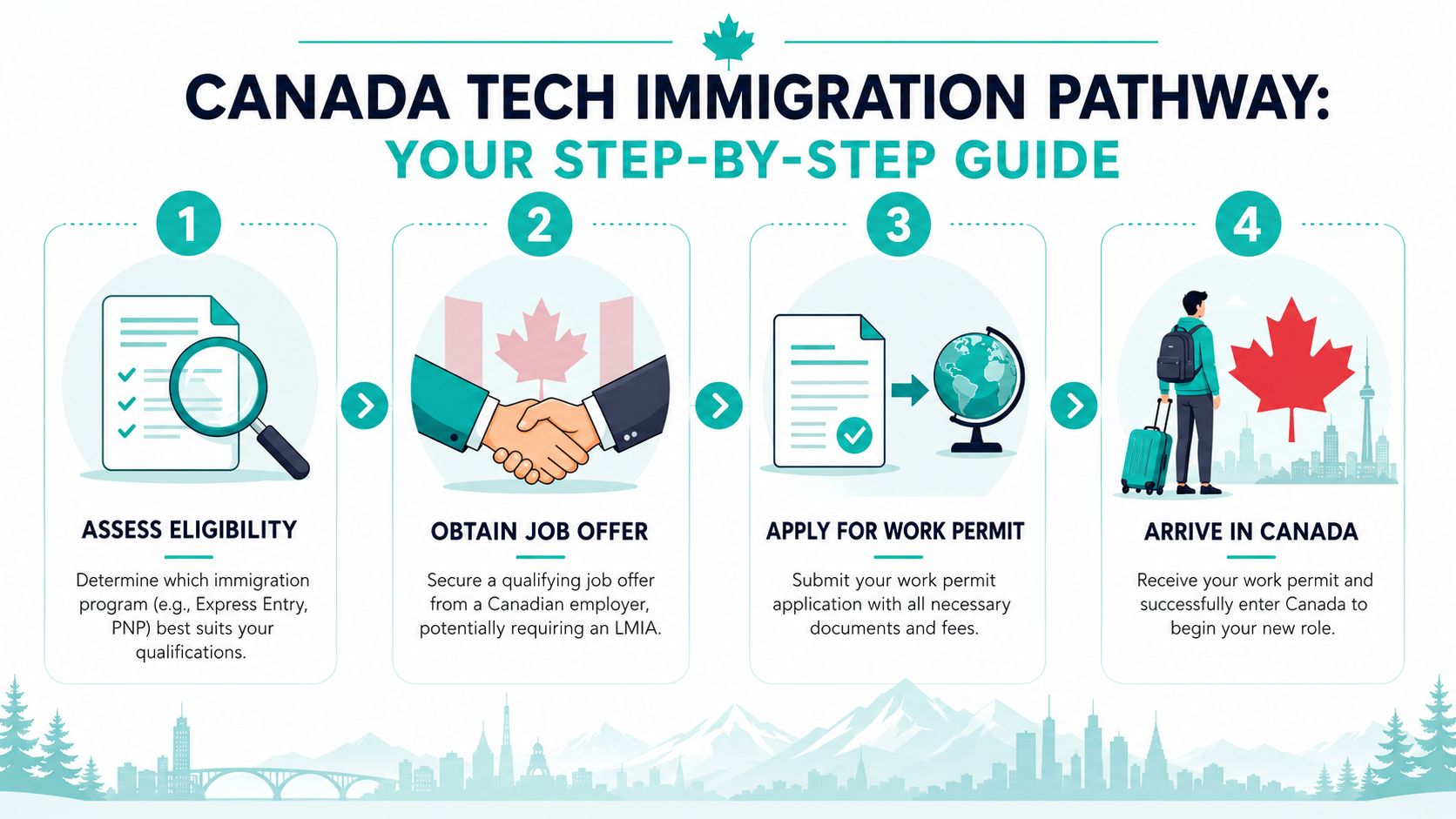
Software engineers usually approach Canada through one of two routes.
The first is employer-supported work authorization. You get an offer, the company agrees to support the process, and your ability to work is connected to that role. This can work well with larger employers and teams that have already hired internationally. It can also fall apart with smaller companies that like your profile but have never handled immigration paperwork and lose confidence after the first internal review.
The second is the independent route, where you secure permanent residency first or get far enough along that your status is straightforward to explain. That lowers friction with employers because they are hiring a candidate, not solving an immigration problem at the same time. The trade-off is time, paperwork, and less control over hiring timing while your application is still in progress.
The strategic question is the same one that shows up throughout this search. Do you want the cleaner fit of a local Canadian employer, or are you also considering a remote U.S. role from Canada? If you are pursuing remote U.S. companies, Canadian work authorization may matter less for the job itself, but it still matters for where you live, pay taxes, and set up your long-term options. If you are targeting Canadian employers, your status needs to be easy to explain in under a minute.
Recruiters want an operational answer, not a legal essay.
A strong response covers three points. Your current status. Whether employer support is required. The path you expect to use, stated in plain language.
Use direct wording:
Weak answers usually sound broad and noncommittal. "I am open to relocating" is not an answer. "I can figure that out later" is worse.
Many international candidates waste time applying to every interesting software role, only to discover half the companies are only set up for candidates who can start without support.
Use a simple filter. Prioritize employers with an established Canadian entity, a visible engineering team in Canada, and recruiters who can explain the process without sending you to a generic inbox. Larger firms tend to be better here, but size alone is not enough. A mid-sized company that hires cross-border every quarter is often easier to work with than a famous startup doing its first international hire.
This is also where your Canada versus remote U.S. decision matters. A Canadian company may offer lower compensation, but the employment setup is often cleaner. A U.S. remote offer can be stronger on cash, yet the hiring structure may involve contractor status, an employer of record, or tighter location rules than the recruiter first implied. Ask early how the company employs engineers in Canada.
If your work authorization needs explanation, turn it into a short, recruiter-friendly script before your first screen.
Before you start interviewing, make sure you can answer these questions without improvising:
Write those answers down. Then make sure your LinkedIn profile, application responses, and resume all point in the same direction. If your application materials need tightening, this guide on how to write a tech resume is a useful reference.
Clarity wins here. You do not need every detail resolved before you apply, but you do need a plan that sounds real to the person deciding whether to move you forward.
Most software resumes don't fail because the engineer lacks skill. They fail because the document reads like a stack inventory.
Canadian hiring teams scan for relevance fast. They want to know what you built, how close you were to production, what level of ownership you held, and whether your experience maps to the actual role. If your resume says “worked with Python, AWS, Kafka, PostgreSQL,” that's not a case for hiring. That's a shopping list.
Start with presentation basics. Keep the format clean, readable, and conservative. Don't add a photo. Don't include personal details that aren't job-relevant. Don't turn the top third of the page into a paragraph about your passion for technology.
A strong resume earns attention by matching the employer's problem.

Many experienced engineers still undersell themselves; if a data-heavy backend role requires depth in databases, pipelines, and warehouse architecture, you need those exact themes to appear in your bullets in credible language.
A recent Canadian posting for a senior software engineer with data specialization required 5+ years in relational databases, 5+ years building batch and real-time data pipelines, and 5+ years with ETL/ELT and data warehousing, as shown in this Canadian senior software engineer data job listing search. That tells you how screening works. The employer isn't casually interested in those areas. They're treating them as mandatory competency clusters.
So don't write this:
Write bullets that prove fit more directly:
Those bullets are still qualitative, but they signal the right shape of experience.
A useful structure is simple:
You don't need to force fake metrics. If you don't have numbers you can stand behind, stay qualitative. But do finish the thought.
Bad bullet:
Better bullet:
That second version sounds like a real engineer wrote it.
One of the best resume habits is making a “master resume” and then cutting role-specific versions from it. If you're applying to data platform roles, your most relevant database and pipeline work should move up. If you're targeting product engineering roles, bring user-facing shipping work and cross-functional collaboration to the top.
For a practical breakdown of how to structure that document, this guide on how to write a tech resume is a useful reference point.
Your resume should make the recruiter's first conclusion easy: “This person has already done work close to what we need.”
Here's what usually helps:
What usually hurts:
If you want a software engineering job in Canada, make the resume read like proof of delivery. That's what gets interviews.
Mass applying feels productive because it creates motion. It usually creates noise instead.
A better search has lanes. One for startups. One for larger employers. One for recruiter-led opportunities. One for remote roles that happen to be open to candidates in Canada. Each lane behaves differently, and your preparation should match it.
Large enterprises in Canada often care about process maturity. They want engineers who can work within established systems, document decisions, collaborate across teams, and adapt to slower-moving environments without creating friction. You're often evaluated on consistency and execution.
Startups usually compress that evaluation. They still care about code quality, but they screen harder for judgment. Can you ship with limited structure? Can you handle incomplete requirements? Can you talk to product and design without sounding territorial? Can you make technical trade-offs without hiding behind process?
A recent Canadian posting for an Expert Manager, Software Engineering required 6+ years of end-to-end production application experience, direct stakeholder translation into roadmaps, and familiarity with CI/CD and Git, while also listing modern AI/ML tooling like RAG pipelines as ideal in this Expert Manager, Software Engineering role in Canada. That's a good snapshot of where senior hiring is moving. Shipping matters. Stakeholder translation matters. Modern tooling exposure matters.
You don't need more platforms. You need better use of a few.
Some candidates use broad job boards for market visibility, then layer in more focused channels. For startup-oriented searches, niche resources often produce better-fit roles than generic boards. If you want a broader menu of places to search, this roundup of the best job search sites for software engineers is a practical place to compare options.
If you're on the hiring side or you want to understand how companies frame role requirements, MyCulture.ai's software engineer hiring is also useful context because it shows how employers think about technical and team fit beyond a keyword checklist.
A strong search mix usually includes:
A lot of candidates over-index on pure algorithm prep and under-prepare for practical discussion. Canadian teams often want to hear how you think with other people in the room.
That means preparing for questions like:
The candidates who do well aren't always the ones with the slickest theoretical answers. They're the ones who can explain real engineering work clearly.
For system design, use concrete examples from your own background. For behavioral rounds, don't memorize polished stories. Pick a few real projects and learn how to discuss architecture, ownership, conflict, and outcomes from each.
That's what makes you sound senior.
Most candidates compare offers too narrowly. They look at base pay, maybe bonus, then stop. That's a mistake even within Canada. It's a much bigger mistake if you're also considering remote U.S. roles from Canada.
A software engineering job in Canada now sits inside a split market. One part is domestic and tied to Canadian employer norms, payroll, and benefits. The other includes U.S.-based employers willing to hire remote talent in Canada. Those aren't just higher-paying versions of the same decision. They create different tax, currency, hours, and long-term career trade-offs.
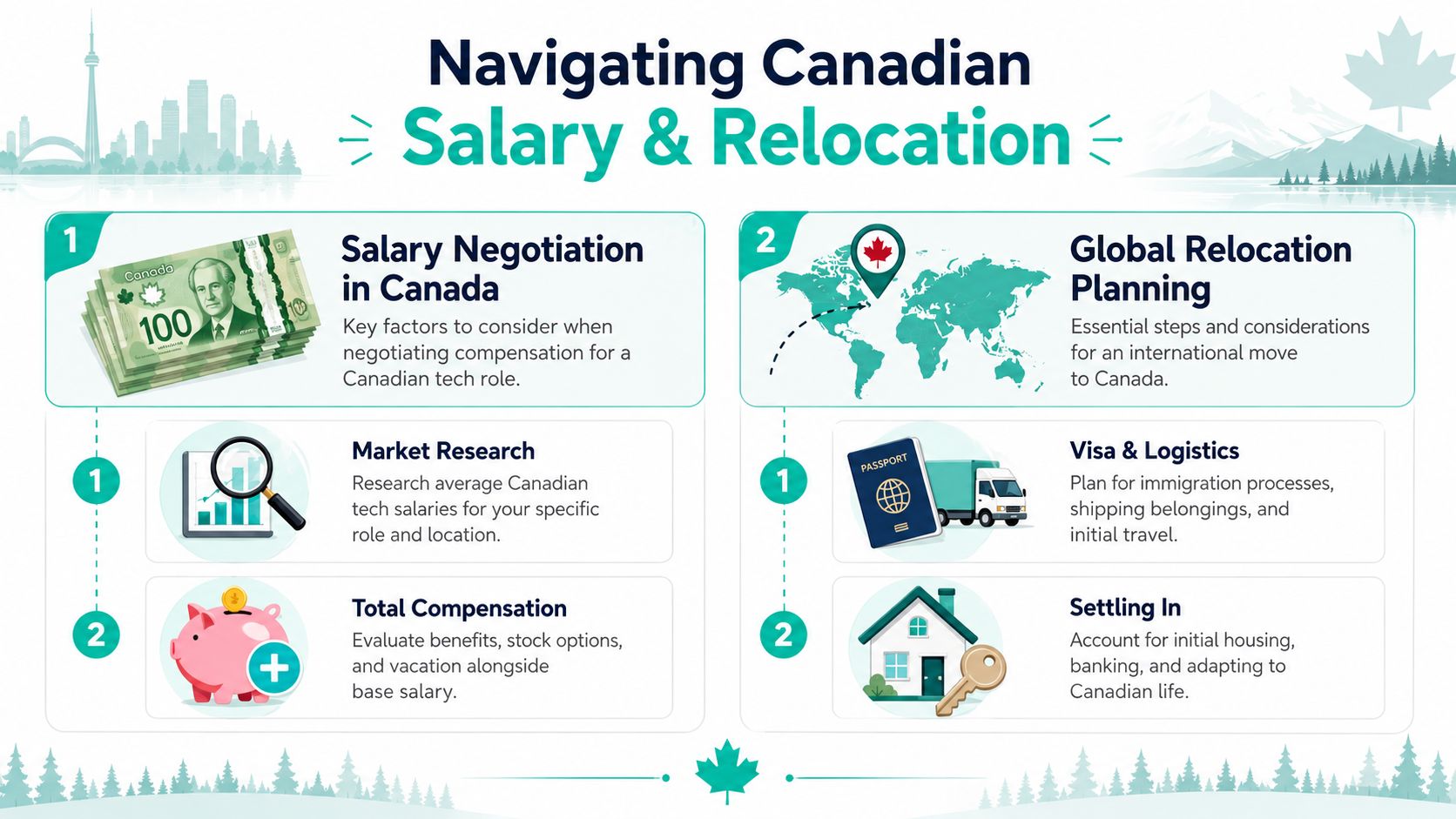
Some U.S. employers recruit remotely in Canada for roles paying up to USD $200,000 per year, as described in this remote software engineer jobs in Canada overview from Crossover. That's the number that gets attention, but it shouldn't be the only thing driving your decision.
A local Canadian offer can still be the stronger move if it gives you better role scope, a more credible title path, stronger benefits, cleaner immigration support, or a team that compounds your experience in the right direction.
Use a side-by-side framework.
| Offer factor | Local Canadian role | Remote U.S. role from Canada |
|---|---|---|
| Currency exposure | Simpler if paid in CAD | More upside possible, but currency matters |
| Benefits structure | Often aligned to local norms | Can vary a lot by employer setup |
| Immigration support | More likely if relocation is involved | Often less relevant if you already work from Canada |
| Time zone and collaboration | Usually cleaner for local teams | Depends on where the U.S. team operates |
| Career signaling | Helpful for building Canadian employer brand | Helpful if company quality and scope are strong |
Candidates often get shy at this stage. Don't.
Negotiate the full package:
For a broader grounding in compensation thinking, this overview of software engineering salary is a useful companion.
If you're moving provinces or entering Canada from abroad, relocation costs and logistics affect the effective value of the offer even when the base looks solid.
Focus on the first weeks, not the first year.
A rushed move can make a good offer feel bad. A well-planned move lets you focus on the job itself.
The best offer is the one that still looks good after you account for currency, benefits, role quality, and the practical cost of starting the job.
Getting a software engineering job in Canada is less about chasing volume and more about making clean decisions. Choose a target market. Know your work authorization story. Write a resume that proves shipped work. Search through the right channels. Then compare offers based on the life and career they create, not just the headline number.
That's the difference between a scattered search and a disciplined one.
Canada remains a credible market for engineers who bring real production experience, clear communication, and a focused application strategy. For some people, the right move will be a local role in Toronto, Vancouver, or Montreal. For others, the strongest path will be living in Canada while working remotely for a U.S. employer. Both are valid. They just require different filters.
Treat the process like an engineering problem. Define constraints, evaluate trade-offs, and optimize for the outcome you want.
If you're also considering startup and high-growth roles beyond Canada, Underdog.io offers a curated way to get in front of tech companies through a short candidate application, which can be useful if you want another channel alongside your direct applications.