The Bay Area keeps absorbing attention because it keeps absorbing capital. In 2025, the region captured over $122 billion in AI funding alone while the broader startup ecosystem raised over $114.13 billion across 17,298 active startups, according to Visible’s Bay Area VC analysis. That scale changes behavior on both sides of the hiring market.
Candidates feel it as velocity. Recruiters feel it as pressure. Founders feel it as a constant race to hire before the next company does.
Most coverage of startups in bay area stops at hype. It names the obvious companies, recycles the same neighborhoods, and treats the market like one giant, interchangeable tech blob. That’s not how it works on the ground. A machine learning engineer looking at Hayes Valley, a PM considering a South Bay infrastructure startup, and a seed-stage founder in Oakland all operate in different hiring environments.
The useful way to look at this ecosystem is as a set of overlapping talent markets. Some are loud and heavily intermediated. Others are opaque, under-covered, and full of better-fit opportunities than the headline names. If you’re exploring the region from outside the U.S., it’s also worth seeing how other hubs try to replicate this density of capital and operator networks, like this look at Silicon Valley in Dubai, because it highlights what’s hard to recreate: concentration, speed, and trusted networks.
This guide is for both people trying to join startups in bay area and teams trying to hire inside it. The same market forces shape both decisions. The difference is whether you’re evaluating the company, or the company is evaluating you.
The Bay Area startup market runs on compression. Capital, talent, customer feedback, and follow-on hiring all happen faster here than in most other tech hubs.
That speed is the defining feature. It affects how companies raise, how quickly teams form, and how little time either side has to make a bad decision and recover from it. For job seekers, that means a role can move from exploratory conversation to final interview very quickly. For hiring teams, it means a strong candidate can disappear from the market before your internal debrief is finished.
The usual explanation is “there’s more money here.” True, but incomplete. The more useful explanation is that startups in bay area operate inside a dense feedback loop. Investors are nearby. Operator communities overlap. Specialized recruiters, angel networks, and founders talk constantly. Product leaders change companies and bring prior teammates with them.
That’s why the Bay Area often feels small even when it’s enormous.
Practical rule: In this market, reputation compounds faster than credentials. People remember who ships, who hires well, who drags out interview loops, and who closes candidates cleanly.
For candidates, this means your network matters, but not in the shallow sense of collecting coffee chats. It matters because references, warm context, and team-specific credibility cut through noise. For startups, it means your employer brand isn’t your careers page. It’s what recent candidates and former employees say privately.
A lot of people still approach the region the wrong way.
The Bay Area rewards precision. Broad interest gets lost. Specific interest gets meetings.
Bay Area startup hiring runs through a handful of dense submarkets, and each one behaves differently. For candidates, that changes interview speed, compensation pressure, and how much in-person access matters. For hiring teams, it changes who enters your funnel in the first place.
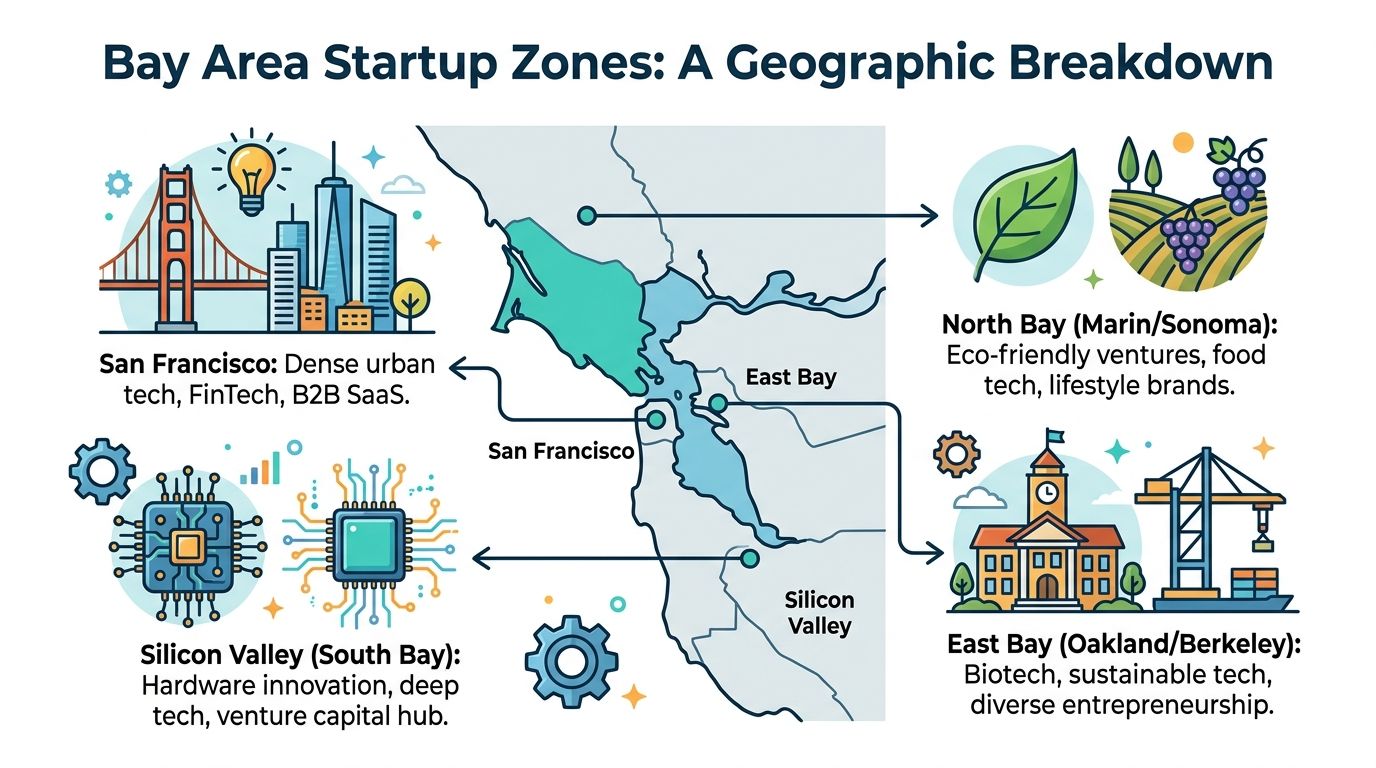
San Francisco still has the highest concentration of founder activity, investor presence, and fast-moving startup teams. SoMa, Mission Bay, and Hayes Valley remain the best-known nodes. The recent AI cluster around Hayes Valley and SoMa, often called “Cerebral Valley,” has pulled even more attention to the city, as noted in Visible’s Bay Area VC report.
That concentration has practical consequences.
Candidates usually see tighter interview loops here. Founders can pull together a recruiter screen, hiring manager conversation, technical interview, and office visit in the same week. Teams hiring in AI product, infrastructure, developer tools, and B2B software also benchmark talent against a very local peer set, so weak positioning shows up fast.
For hiring teams, San Francisco gives access to dense talent networks and faster closing cycles. It also raises the bar on clarity. Vague job scopes, slow feedback, and inconsistent compensation bands lose candidates quickly because good people have nearby alternatives.
The South Bay still produces a large share of the region’s serious company-building. Palo Alto, Mountain View, Sunnyvale, and San Jose remain strong for enterprise infrastructure, hardware-adjacent products, security, semiconductors, and other technically demanding businesses.
The operating style is different from the city. Companies often have more layered leadership teams, clearer functional ownership, and more structured hiring processes. That can feel slower to candidates used to San Francisco speed, but it often means better onboarding, steadier management, and a cleaner view of what success looks like six months in.
This is also where overlooked middle-market startups show up. They may not dominate social feeds, but they often have real revenue, durable customer demand, and room for strong operators to make visible impact without unicorn-level noise.
Oakland and Berkeley serve a different slice of the market. You see more research-linked teams, climate and energy companies, biotech, and startups that pull talent from universities and labs.
The appeal is not just cost or commute. The East Bay tends to attract founders and employees who are optimizing for domain fit and staying power. In practice, that means candidates can find companies with deeper technical moats and less performative startup culture. Hiring teams can also reach people who are selective about mission, work environment, and team quality, not just valuation headlines.
Geography shapes that pipeline. A Berkeley deep-tech company should write a different pitch than an AI application startup in SoMa. If both use the same job description, one of them will miss the audience it needs.
The North Bay matters less for pure software density, but it shows up in climate-adjacent businesses, food, wellness, consumer categories, and a smaller set of specialized operating models. For some founders, that trade-off makes sense because the company’s product, customers, and culture align better there than they would in downtown San Francisco.
Hiring is narrower here. So is competition.
That can work well for teams with a clear category focus and realistic expectations about onsite talent. It is usually a weaker fit for companies that need constant cross-pollination with dense engineering communities.
| Region | Key Hubs | Startup Focus | Dominant Vibe | Best For |
|---|---|---|---|---|
| San Francisco | SoMa, Mission Bay, Hayes Valley | AI, B2B SaaS, fintech, product-heavy startups | Fast, networked, founder-dense | Candidates who want speed and visibility |
| South Bay | Palo Alto, Mountain View, Sunnyvale, San Jose | Enterprise infrastructure, hardware, deep tech | More structured, execution-driven | Builders who value depth and operating rigor |
| East Bay | Oakland, Berkeley | Biotech, sustainable tech, research-connected startups | Mission-led, academic-adjacent, varied | People optimizing for focus and fit |
| North Bay | Marin, Sonoma pockets | Climate-adjacent, food, wellness, lifestyle | Lower-noise, niche | Founders and operators with category-specific goals |
Job seekers should sort the market by work style before sorting by brand. If you want high-velocity product iteration and frequent in-person founder access, start in San Francisco. If you want stronger process, more technical depth, or a less hype-driven environment, the South Bay and parts of the East Bay usually offer better options. For a broader view of how those company types differ across the region, Underdog’s guide to start-up companies in Silicon Valley is a useful companion.
Hiring teams should make location strategy explicit. “Bay Area role” means very little if the actual expectation is three or four days onsite in Mountain View or Berkeley. Geography functions as a strategic choice, not just a branding exercise. Teams that state the commute reality, office cadence, and local talent thesis upfront tend to attract better-matched candidates and waste less time.
The obvious bet is AI. The better question is which part of AI, and whether the company is building core technology, applied workflow software, or selling an AI label on a conventional SaaS product.
That distinction matters because the hiring profile changes completely. A research-heavy startup needs a different kind of engineer than an applied AI company embedding models into sales ops, healthcare workflows, or customer support.

The Bay Area has scale in AI, but the interesting hiring signal is specialization. Bay Area startups include 102 YC-funded machine learning companies and 38 data engineering firms, creating strong demand for specialists in vector databases and causal ML, according to Y Combinator’s Bay Area data engineering company set.
That tells you two things.
First, general “AI interest” isn’t enough anymore. Second, infrastructure knowledge has become a practical differentiator. Teams want people who understand retrieval systems, model evaluation, data quality, orchestration, and production trade-offs. In real hiring conversations, that often means candidates who can speak concretely about tools like PyTorch, dbt, Snowflake, Pinecone, Weaviate, or feature store design have a sharper edge than candidates who only talk about prompts and prototypes.
A lot of strong startups in bay area aren’t chasing consumer buzz. They’re building software for messy, underserved industries where the workflow pain is real and the market narrative is quieter.
Examples named in reporting on this trend include ServiceTitan serving contractors, Seso focusing on agricultural workers, and Traba serving light-industrial staffing, as discussed in Digital Native’s coverage of startups building for tech’s blind spots. These companies appeal to a specific kind of candidate. Usually someone who likes hard operational problems, complicated end users, and products that need real-world adoption rather than social hype.
The best Bay Area opportunity is often the one your smartest friend joined before anyone else started posting about it.
For candidates, these vertical startups can be excellent fits if you want mission alignment and clearer product-market pull. For hiring teams, they require a different pitch. You usually won’t win by prestige. You win by showing the depth of the customer problem and why the work matters.
Applied AI gets attention, but data engineering remains a durable center of gravity. Companies can’t ship good AI products without strong data plumbing, observability, reliability, and governance.
That’s why strong data engineers remain attractive across sectors. In the Bay Area, they aren’t just supporting analytics teams. They’re shaping model inputs, experimentation systems, and customer-facing performance.
Here’s where I see teams make mistakes:
Candidates should listen for that mismatch. If the hiring manager can’t explain where data infrastructure sits in the product strategy, the role may be less influential than the JD suggests.
Don’t sort sectors only by funding heat. Sort them by fit.
Ask yourself:
Those answers usually point you toward the right subset of startups in bay area faster than any “top companies” list.
The Bay Area hiring market moves fast enough that people often evaluate offers badly. They anchor on salary, rush through equity, and forget that stage, hiring urgency, and company quality all affect the overall package.
That’s a mistake on both sides. Candidates leave money or upside on the table. Startups lose trust by presenting compensation as simpler than it is.
In the Bay Area, startups with Series Seed to B funding scale engineering teams 2 to 3 times faster than non-Bay Area peers, with median team size doubling within 12 months post-funding, according to GrowthList’s San Francisco startup analysis. When a company is in that mode, hiring urgency goes up and compensation gets more competitive.
You’ll feel that in process design. Recruiters follow up faster. Hiring managers compress loops. Founders get involved earlier. Offers often come with less drift between final round and close.
That doesn’t automatically mean “better” offers. It means more aggressive ones. Sometimes that aggression shows up in salary. Sometimes in equity. Sometimes in title. You need to know which lever the company is using.
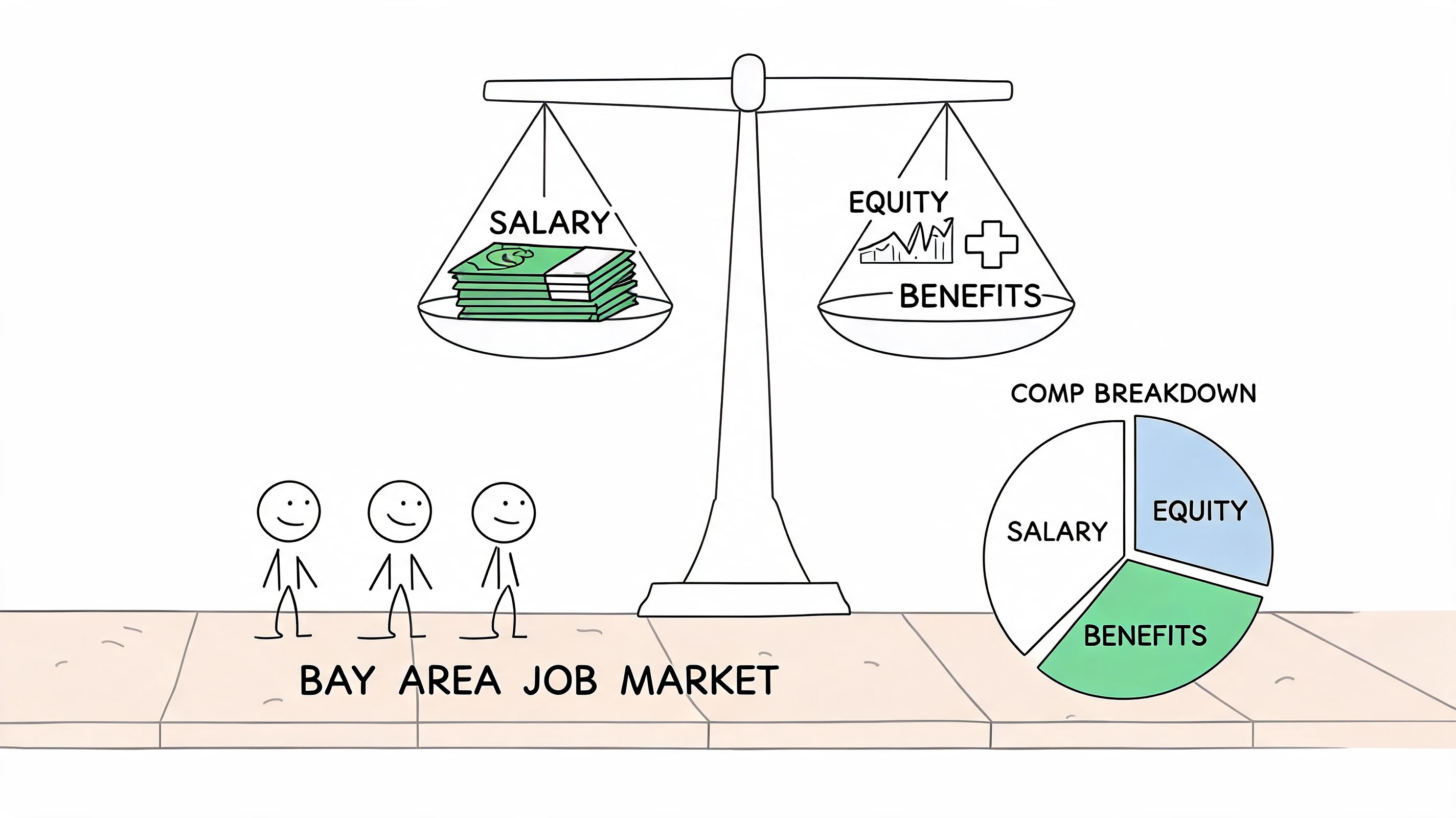
A startup offer usually includes base salary, equity, benefits, and sometimes a signing element or future refresh logic. The exact shape varies by stage and role.
The mistake I see most often is treating equity as either magical upside or meaningless lottery tickets. It’s neither by default. It’s one component that only makes sense in context.
When you evaluate equity, ask practical questions:
If you need a better framework for parsing trade-offs between salary, equity, and benefits, this guide on compensation and benefits is a useful baseline.
Strong Bay Area candidates don’t just negotiate harder. They negotiate cleaner. They know which variables matter to them before the offer comes.
Offer rule: If you wait until the written offer to decide what you care about, you’re already behind.
A few practical examples:
For the application itself, signal quality still matters. Most startup resumes are too generic, too task-heavy, and too detached from actual outcomes. A practical resource for tightening that up is this guide on how to write a resume that gets hired, especially if you need to make startup-relevant work legible quickly.
Fast hiring doesn’t help if your process is muddled. The strongest Bay Area startups close well because they align internally before they talk to candidates. They know the must-haves, the nice-to-haves, and the compensation philosophy.
Hiring teams should pressure-test four things before opening a role:
If you can’t answer those questions, the market will expose it fast.
Many evaluate startups backwards. They start with visibility, then work backward to quality. That’s why they over-index on funding announcements, social buzz, and familiar logos.
In the Bay Area, that approach misses too much of the market. While coverage focuses on top-tier firms, there are over 74,000 startups in the Bay Area, and the median company is underfunded and largely invisible, creating a middle-market hiring gap and a real opportunity for candidates who can evaluate beyond headlines, according to Y Combinator’s Bay Area marketplace category data.

This is the slice of startups in bay area that serious candidates should spend more time on. Not because every quiet startup is great. Many aren’t. But because the information edge is better if you know how to vet them.
A lesser-known company can offer stronger scope, more direct access to founders, and more influence on product direction than a louder, better-funded name. The trade-off is that you have to do real diligence yourself.
That diligence starts with the founders.
Founders set the operating cadence. A lot of startup quality can be inferred by how they think, hire, and communicate.
Look for:
Then move to the product. You don’t need private dashboards to form a view. You need evidence that the company is solving a painful problem for a real user group.
Useful signals include product specificity, credible customer language, and a hiring plan that matches the business. If a startup claims to be enterprise-focused but is hiring only growth marketers and generalists, ask why.
Candidates are often too cautious here. You don’t need to interrogate a founder. You do need to ask questions that expose how the business works.
Try questions like these:
Those aren’t performative investor questions. They’re operator questions. Strong teams usually answer them well.
If a company can explain its constraints clearly, that’s often a better sign than polished optimism.
Candidates overrate brand and underrate manager quality. They also underestimate how much cultural friction can matter in a small team. A startup can have a smart founder, solid funding, and a miserable day-to-day environment.
Watch for these warning signs:
For hiring teams, the lesson is simple. If you’re not a known brand, don’t try to act like one. Unknown startups win by reducing ambiguity. Show the mission, explain the constraints, and introduce candidates to the people they will build with.
The Bay Area job search still rewards warm context, but “networking” is too broad a word for what is effective. Your objective is building intelligence. You want to understand which teams are serious, which managers are respected, and which openings are worth your time before the wider market catches up.
That usually doesn’t happen through random cold messages.
The strongest networking moves are adjacent to real work. Engineers get traction by contributing to open-source projects, showing up in technical Slack groups, discussing infrastructure choices in public, or attending meetups tied to their actual domain. Product and design candidates do better when they can discuss user trade-offs, not just say they’re “interested in startups.”
A few tactics work consistently:
Too many candidates treat startup interviews like auditions. In good startup hiring, the process is mutual evaluation. You’re assessing judgment, management quality, and whether the company knows what it’s hiring for.
Different startups run different loops, but most include some mix of recruiter screen, hiring manager call, practical exercise, cross-functional interviews, and founder conversation. Your job is to understand what each stage is testing.
For a cleaner breakdown of how to prepare for each part, Underdog’s guide on how to do a good job interview is a solid reference.
They don’t just answer well. They calibrate to the company.
That means:
A good final-round question is often simple: “What does great look like in this role after I’ve been here long enough to matter?” The answer tells you a lot about whether the company hires intentionally or just hires urgently.
Interviews reveal company quality in small moments. Who is prepared, who is curious, who follows up, and who can explain the work without jargon.
The Bay Area startup market has no shortage of openings. It has a filtering problem.
Candidates can find hundreds of roles across AI, infrastructure, healthtech, climate, fintech, and developer tools. Hiring teams can access large pools of engineers, PMs, designers, and operators. Yet both sides still waste time on poor matches, because surface-level signals carry too much weight. Brand name, funding headline, and job title often hide the details that determine success in a startup role.
A curated search fixes that by shrinking the market to the slice that fits.
For candidates, that means choosing for stage, manager quality, product category, and working style before sending applications. A Series A startup with sharp product momentum and thin process is a different bet from a 400-person company that still calls itself a startup. Both can be good opportunities. They just reward different people. The same goes for middle-market startups that rarely trend on social media but often offer better scope, more stable execution, and clearer hiring plans than louder companies.
For hiring teams, curation improves signal. A smaller pipeline of people who understand the role, want the company’s stage, and can explain relevant trade-offs beats a large inbox full of generic interest. That is especially true in the Bay Area, where experienced candidates are often choosing among public companies, well-funded startups, and profitable private firms at the same time.
Underdog.io is one example of that model. It runs a curated hiring marketplace where candidates submit one application and vetted startups reach out when there is mutual fit. The value is not volume. It is reducing noise for both sides.
A strong Bay Area startup match usually comes down to three variables:
Miss one, and the role becomes harder to sustain. Miss two, and turnover usually follows.
This is why experienced operators do not optimize for hype alone, and good hiring teams do not optimize for applicant count alone. They look for fit across product, people, and timing. In practice, that often points to overlooked companies in the middle of the market: startups with real revenue, smaller brands, disciplined founders, and roles with wider ownership.
That segment matters more than people think.
If you are a candidate, a curated approach helps you avoid spending weeks on companies that were never a fit on stage, expectations, or management quality. If you are hiring, it helps you spend time with people who chose your company for reasons that hold up after the offer is signed. That is how this market starts to make sense.