Underdog.io accepts only about 5% of applicants and connects startups with vetted candidates through human-powered matching, not algorithms. That selectivity matters because startup hiring usually fails from too much low-signal volume, not from a complete absence of capable engineers.
The familiar scene is painful. You publish a backend role, share it across several platforms, and spend the next few days sorting through applications that match keywords but miss the actual requirements. The team needs someone who can work through ambiguity, ship without a large support structure, and make sound trade-offs. A broad applicant stream rarely reveals those qualities.
I've hired through referrals, job boards, agencies, and private networks. Each channel can work, but they solve different problems. Job boards maximize distribution, agencies outsource parts of the search, and curated tech talent networks reduce the distance between a startup and candidates who have already passed a meaningful quality filter.
The hidden cost of a “free” posting is the founder's attention. Every irrelevant application consumes review time, interview capacity, and decision-making energy. That cost becomes particularly visible when the role is urgent and the engineering team is already carrying product work.
A founder can post a backend role in the morning and spend the afternoon sorting applications instead of reviewing product decisions. The job description may be clear, yet the inbox fills with keyword matches, incomplete profiles, and candidates who have not understood the role. By the time the team identifies a credible shortlist, strong applicants may already be in other processes.
The market contains capable people. The bottleneck is identifying the right ones quickly and giving them a credible reason to engage. By January 2025, more than 3.3 million job seekers in U.S. technology occupations were active on Indeed. Indeed's overview of technology occupations shows the scale of the searchable pool, but a large database does not establish fit, availability, or the ability to operate in a startup.

A free job board shifts the bill from posting fees to internal time:
The hidden cost is attention. Startup hiring needs signal compression, reducing a broad pool to candidates with a plausible match for the role, company stage, and working environment.
Agencies provide another option, but a commercial search brief can miss technical constraints or the realities of an early team. A curated network occupies the space between an open board and a full-service agency. It improves the starting pool while leaving the hiring decision with the company.
Employer behavior reflects the limits of any single channel. A 2025 survey found that 55% of companies most often reached tech talent through LinkedIn and similar sites, while 51% used partnerships with technical training programs and 50% used specialized job postings. The latest tech hiring trends help explain why startups combine distribution with selective screening rather than relying on one public listing.
Underdog.io reports that it accepts about 5% of applicants, a meaningful filter before a startup reviews a profile. That process does not replace interviews or references. It removes some low-signal work before those steps begin, which matters when a small team is hiring under delivery pressure.
The same discipline applies outside engineering. For appointment setters, defining the traits to assess before reviewing candidates prevents volume from replacing judgment. BAMF's guide to key questions for hiring appointment setters offers a practical example of structured evaluation.
Curated networks do not eliminate hiring work. They move more of it toward real evaluation and away from inbox triage.
A tech talent network is more than just a job board with a smaller audience. It's a controlled marketplace with standards on both sides. Candidates are reviewed before they enter, employers are screened before they can approach the pool, and introductions are made with context rather than generated from a keyword match.
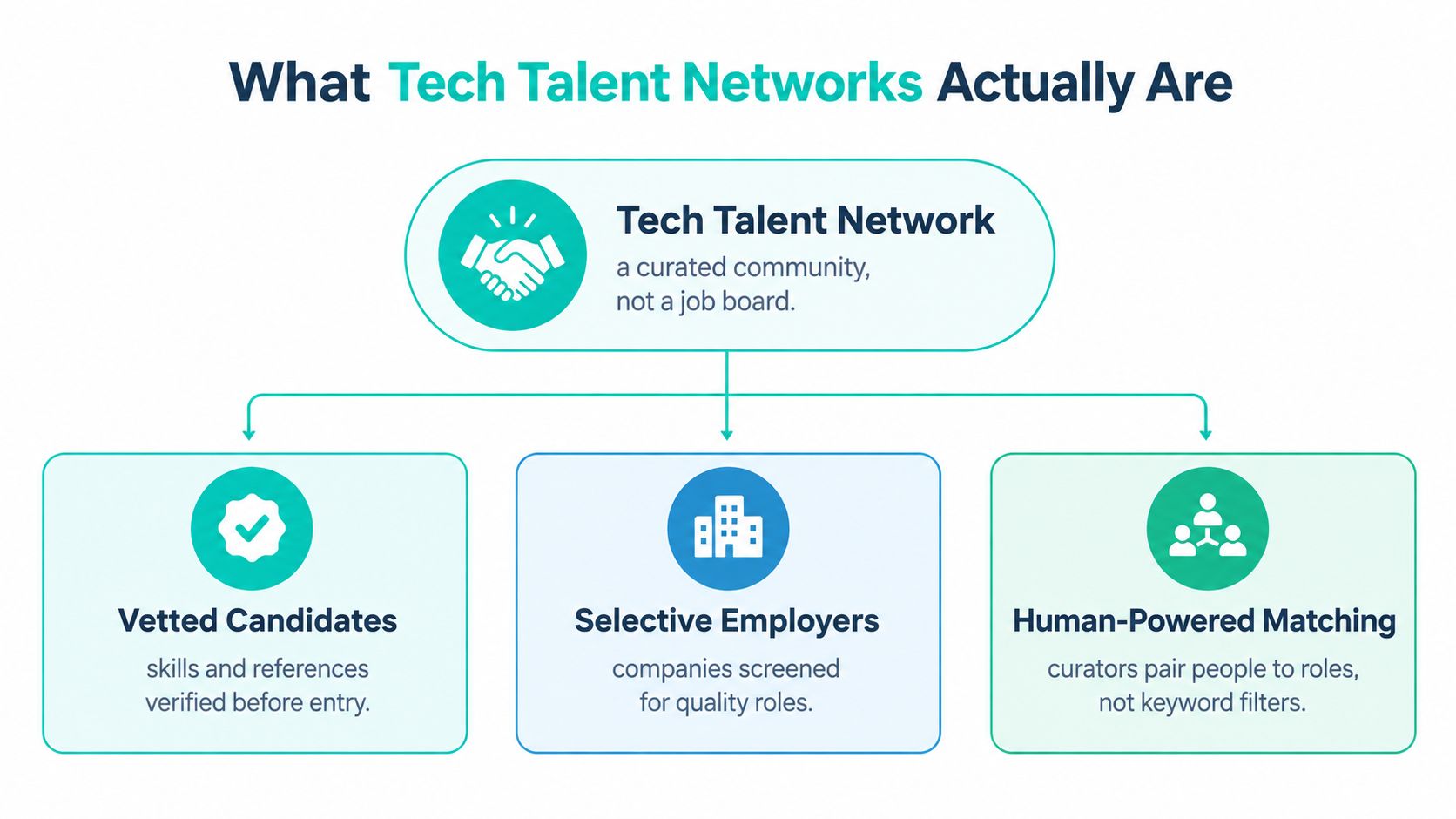
Candidate vetting is the first filter. A credible network looks at the person's actual experience, role scope, technical background, and suitability for the companies it serves. Manual review matters because a resume can contain the right terms while omitting the context that determines whether someone can succeed in a startup.
Employer selectivity is the second filter. Candidates should know that the companies contacting them have real roles, a credible operating context, and expectations worth discussing. A network that screens only candidates but accepts every employer hasn't solved the marketplace problem. It has only shifted the noise.
Human matching is the third. Curators can notice distinctions that keyword systems miss, such as whether a product manager has operated in an early-stage environment, whether an engineer prefers ownership over specialization, or whether a designer's portfolio reflects the pace of a small team.
Underdog.io accepts only about 5% of applicants through manual review, keeps profiles anonymous until mutual interest, and typically provides 1 to 3 personalized introductions per month, according to its description of its recruiting software for startups. Underdog.io's account of its selection process demonstrates the operating model: fewer introductions, more context, and less exposure for people who aren't actively applying.
Passive candidates rarely want a public job search attached to their name. Anonymous profiles let employed professionals explore opportunities without announcing a move to colleagues or managers. The candidate can decide whether an introduction is worth pursuing before revealing identity.
That control also improves the conversation. Instead of competing with a large inbound queue, a candidate receives a narrower opportunity set and can evaluate the company, role, manager, product, and growth path. The network becomes a relationship channel rather than another application destination.
The model isn't automatically superior. Curation can narrow reach, and a network may not have the right specialist for every role. It also requires trust in the review process. Before joining one, ask how candidates are assessed, how employers are accepted, who makes introductions, and how profile visibility works.
Selection is a feature only when the standards are clear. A platform that uses “exclusive” language without explaining its filters is still a distribution channel, regardless of its branding.
Startups usually choose among three hiring channels. A job board gives the company distribution, an agency supplies recruiting labor, and a curated network offers controlled access to a screened pool. The right choice depends on the role, urgency, internal capacity, and tolerance for noise.
| Channel | Cost | Speed | Quality Control | Best For |
|---|---|---|---|---|
| Job boards | Low direct cost, high internal screening cost | Variable | Mostly employer-owned after applications arrive | Broad awareness and roles with a large candidate market |
| Recruiting agencies | Commercial fee or placement arrangement | Can be fast when the agency has a relevant network | Agency-led sourcing and initial qualification | Teams without recruiting capacity or with highly specialized searches |
| Curated networks | Access model varies, with company-side hiring costs | Faster access to a focused shortlist | Candidate and employer filters, plus contextual matching | Startup roles where fit, discretion, and attention are scarce |
Job boards work when the company can absorb the review burden and the role is easy to describe. They're also useful for testing messaging and reaching people who are actively searching. They don't work well when the hiring manager has limited time or when the role requires nuanced judgment that keywords can't capture.
Agencies make sense when a founder needs someone else to own sourcing, outreach, scheduling, and early qualification. The trade-off is control. The startup may have less visibility into how candidates were approached, what was promised, and which parts of the role were emphasized. Agency quality also depends heavily on whether the recruiter understands the technology and company stage.
Curated networks are most useful when the company wants a smaller, more relevant starting set without handing over the entire process. They're particularly practical for early-stage teams hiring engineers, product managers, designers, and data specialists who need to operate with broad ownership.
The hidden cost of a job board deserves its own calculation. Don't compare only the posting price. Estimate the hours spent reviewing, coordinating interviews, explaining the company repeatedly, and restarting the search after weak matches. A low-price channel can become expensive when senior people perform low-value filtering.
Before choosing, write down four answers:
A comparison of hiring marketplaces, job boards, and job searches helps clarify the distinction. No channel replaces a strong brief, decisive interviews, or honest communication. The channel only determines how much noise reaches those steps.
Candidates should treat a curated network profile as a private positioning document, not a duplicate LinkedIn page. The purpose isn't to list every responsibility. It's to make the kind of work you do, the environments where you perform well, and the problems you want to solve easy for a human curator to understand.
Start with outcomes and scope. “Built internal tools” is weaker than describing the operational problem, the systems involved, and your level of ownership. You don't need confidential company details. You do need enough context to distinguish maintenance work from architecture, feature delivery from product ownership, and participation from leadership.
Use a practical sequence:

An introduction isn't an obligation to interview. Read the role summary, inspect the company's product and team, and ask what prompted the match. A useful first conversation should clarify the manager, decision-making authority, product stage, technical constraints, and expectations for the first months.
Privacy matters most for passive candidates. Keep your profile anonymous until the opportunity is credible, and don't disclose your current employer or sensitive project information before there's mutual interest. Ask how your information is shared and whether you can pause or remove your profile.
Responding quickly helps, but speed shouldn't replace judgment. A concise reply can acknowledge the introduction, state your interest level, and request the missing context. If the role is wrong, a polite decline with a precise reason helps the curator improve future matches.
The strongest candidates don't try to appeal to every startup. They make their preferences legible. A clear profile gives the network enough signal to protect your time and present opportunities that fit your actual direction.
A vetted network can improve the top of the funnel, but it can't rescue an unclear role. Before requesting introductions, the hiring manager should define the problem the new person will own, the decisions they'll make, and the evidence that would demonstrate success. Candidates can't properly evaluate a startup if the company hides its constraints behind generic language.
Write the brief for a capable professional, not an imaginary perfect candidate. Separate requirements from preferences. Explain the product, current team, manager, collaboration model, technical environment, and reasons someone would choose the role over a more established employer.
Use a short internal checklist:
The network's value appears when the company respects the candidate's attention. A curated introduction is warmer than a cold application, but the candidate can still disengage if the team takes too long to respond or changes the role after the first call.
Trusted connections matter in startup hiring because formal employer signals are often incomplete. An academic study found that 76.1% of total hires in startup and growth phases came through networks, with referral-based recruiting reaching 87.9% during the growth phase. The academic study of entrepreneurial hiring networks supports a practical lesson: founders should use trusted channels to establish credibility, then evaluate candidates rigorously themselves.
A network is especially useful for a role where the company needs both technical competence and startup judgment. For example, a software engineer may need to own a service, work closely with product, and make pragmatic decisions without a large platform team. A focused guide to finding software developers can help hiring managers think about sourcing and evaluation together.
Don't ask a network to compensate for an unrealistic package or an incoherent mandate. Improve the role first, then use curation to reach people who are likely to value the opportunity. The best outcome is not the largest shortlist. It's a candidate who understands the trade-offs and still wants the work.
The most common hiring mistake is measuring activity instead of progress. Application counts, profile views, and outreach volume can make a funnel look healthy while the hiring team spends its time on conversations that never had a realistic chance.
The market makes that distinction more important. A 2025 survey found that 65% of technology hiring managers said finding skilled talent was harder than a year earlier, with AI/ML, cybersecurity, data engineering, DevOps, and software engineering among the roles in highest demand. Robert Half's technology hiring research points toward a tighter skills market where access to relevant candidates matters more than broad exposure.
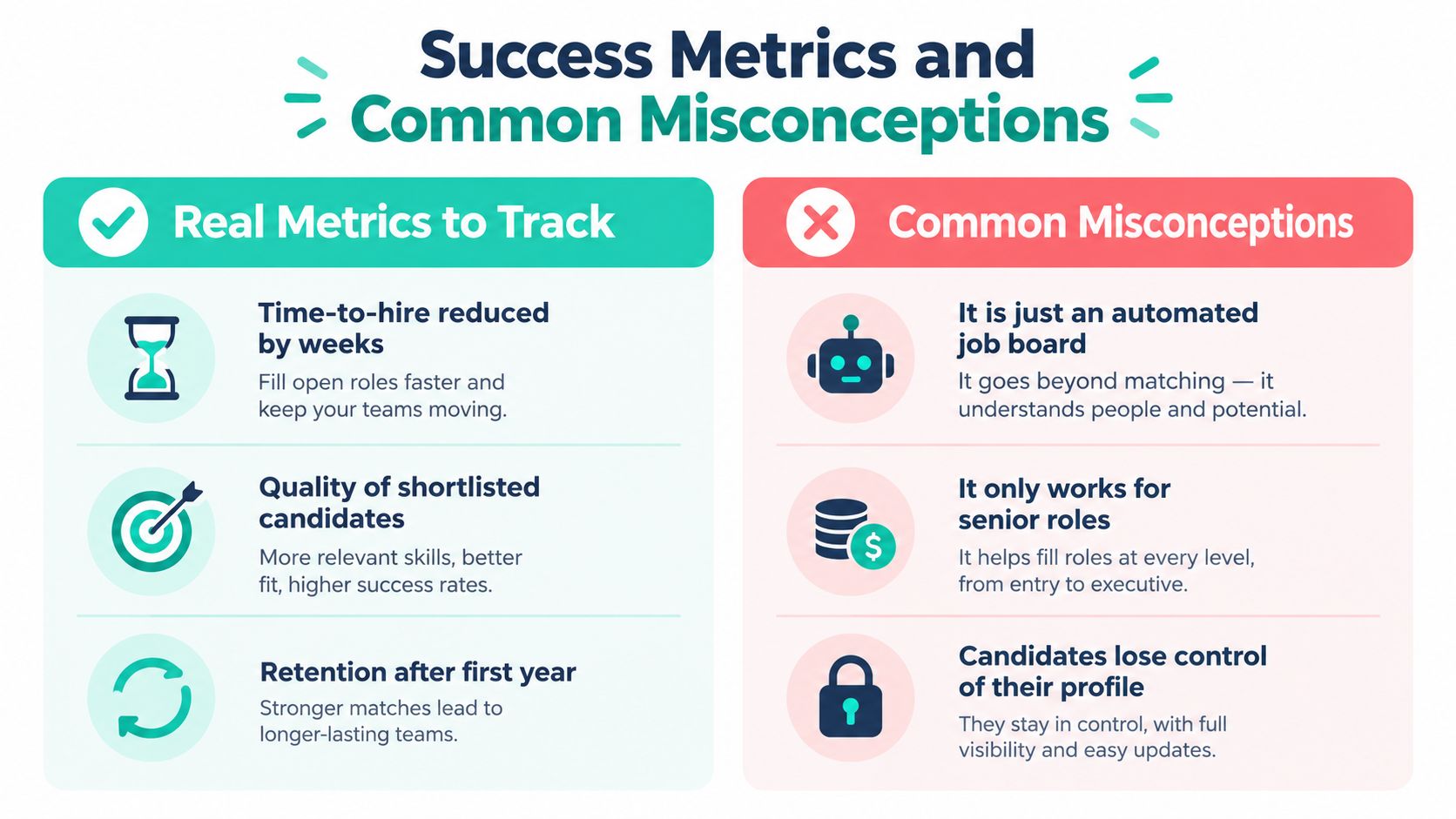
Track the points where a candidate or employer can lose confidence:
These measures expose the underlying economics of free platforms. If a free board produces many applicants but few qualified conversations, the company is paying with engineering time. If a curated network produces fewer introductions but more meaningful interviews, it may be the more efficient channel even when the direct price is higher.
“Curated networks are just automated job boards.” Not if people review profiles, screen employers, and explain the reason for an introduction. Ask who makes the match and what information they use.
“They're only for senior candidates.” Specialization and startup readiness matter more than a single seniority label. A network may be useful for experienced specialists, career movers with strong evidence of ability, or professionals whose work is difficult to discover through standard titles.
“Candidates lose control.” Privacy-first networks can do the opposite when profiles remain anonymous until mutual interest. Confirm the visibility rules, identity controls, and removal process before participating.
“A larger pool always improves hiring.” More options help only when the team can evaluate them well. Once the review queue exceeds the team's attention, additional volume often lowers decision quality.
A curated channel still needs accountable hiring managers, structured interviews, and honest role design. It isn't a shortcut around judgment. It's a way to reserve judgment for candidates who have a reasonable chance of succeeding.
Underdog.io offers a selective, human-curated network where startups connect with vetted tech candidates through anonymous profiles and personalized introductions. Visit Underdog.io to explore a more focused alternative to broad job-board hiring and decide whether its matching model fits your next startup role.