The most common bad advice in technical hiring is simple: check GitHub first.
It sounds smart. Public code feels objective. Contribution graphs look like proof of effort. A polished repository can create the impression that you're seeing how someone really works.
You usually aren't.
That's why GitHub won't help you with hiring, at least not in the way founders, recruiters, and startup hiring managers hope it will. It's a narrow signal, easy to overread, and badly matched to the reality of startup work. Startups need people who can step into messy systems, make tradeoffs, communicate clearly, ship under constraints, and work with other humans. GitHub only shows a thin slice of that, and often not the slice that matters.
The teams that hire well stop treating public code as a shortcut. They build a process that tests judgment, execution, collaboration, and relevance to the role.
The fantasy is familiar. A candidate has steady green squares, a handful of repositories, a few stars, maybe some thoughtful README files, and suddenly the profile starts to feel like a cleaner signal than a resume.
That instinct breaks down fast under real hiring conditions.
In 2020, GitHub reported over 56 million developers and more than 100 million repositories, yet only a minority of those accounts meaningfully reflect professional expertise relevant to hiring decisions. Multiple employer and industry analyses also noted that only about 15 to 20% of GitHub profiles examined by technical hiring managers contain substantive, well-documented codebases that could serve as a realistic proxy for on-the-job performance, as discussed in this critique of why hiring on GitHub falls short.
That should change how you look at the platform immediately. The surface area is enormous. The hiring value is not.
A profile can look active without telling you much. Forked tutorials, old side projects, weekend experiments, abandoned repos, generated commits, and one-person toy apps all create visual activity. None of that tells you how someone handles a production incident, joins an existing architecture, or works through a vague product requirement with design and product.
The inverse is just as important. Some of the strongest engineers have sparse public GitHub histories because their best work lives in private company repos, regulated environments, client systems, or internal tools.
Practical rule: If a signal systematically hides strong candidates and flatters weak ones, it shouldn't sit at the top of your funnel.
Startups often overvalue visible signals because speed matters. That creates a trap. You look for artifacts that are easy to scan instead of evidence that predicts performance.
A hiring process built around GitHub tends to reward:
A hiring process built for actual startup success asks different questions:
Those answers rarely live in a contribution graph.
GitHub isn't useless. It's just weak, noisy, and easy to misuse. For startup hiring, that makes it a bad primary filter.
A 2020 study in IEEE Transactions on Software Engineering analyzed 1,115 developers on GitHub and found that commit frequency, repository count, and stars explained only about 11 to 17% of the variance in code quality metrics such as defect density, technical debt, and code complexity once context and team size were controlled for, as summarized in this analysis of why GitHub won't help with hiring.
That's the core statistical problem. The metrics people like because they're easy to scan don't explain much of what they think they explain.
A lot of excellent engineers spend their time inside proprietary codebases. That includes developers in fintech, healthtech, enterprise SaaS, infra, defense, and any company with serious IP concerns.
When you make GitHub a gate, you subtly filter out people who've spent years solving hard production problems in places where public repos aren't part of the job.
Open source work can be impressive. It can also be a function of schedule, privilege, employer flexibility, or personal interest.
That means GitHub can reward candidates who have the time and motivation to work in public, while penalizing candidates who are just as strong but spend their energy on demanding jobs, family obligations, or domains where public contribution isn't realistic.
A recruiter or hiring manager looking at a repo usually can't tell:
Code without context invites projection. Reviewers fill the gaps with assumptions, and those assumptions are often wrong.
Good hiring signals come with context. Weak signals force the reviewer to invent it.
Startup engineering is collaborative. People review pull requests, negotiate scope, unblock teammates, explain technical debt, and adjust to shifting priorities.
A public repository might show code style. It usually won't show whether someone can disagree productively, communicate risk, or keep momentum during a rough sprint.
Even if GitHub were slightly more predictive, it still wouldn't solve the top-of-funnel problem. Most recruiters don't have the time or technical depth to inspect repositories seriously. Most hiring managers don't have the bandwidth to manually review dozens of public profiles alongside resumes, sourcing, scheduling, and interviews.
Here's the practical summary:
| Failure point | What hiring teams assume | What actually happens |
|---|---|---|
| Visibility | Public code reflects true skill | Public code reflects only what's public |
| Activity | More commits mean stronger engineers | Activity often lacks role context |
| Popularity | Stars and followers indicate quality | Social proof can mislead |
| Fairness | Everyone has equal chance to show work | Many strong candidates can't or don't |
| Team fit | Repos reveal working style | Collaboration remains mostly invisible |
| Scale | GitHub speeds up evaluation | Manual review adds noise and time |
The mistake isn't looking at GitHub. The mistake is believing it can carry hiring decisions.
A startup needs a backend engineer. The hiring manager decides to tighten the funnel by prioritizing candidates with active GitHub profiles. One applicant has a clean public portfolio, frequent commits, and a well-presented set of repos. Another has a strong resume from enterprise infrastructure teams, but barely any public code.
The second candidate gets screened out early.
The startup hires the first one. Within a few weeks, the mismatch shows up where GitHub never could. The new hire can write isolated code, but struggles with legacy systems, vague product asks, and cross-functional communication. They're slower in real code review than expected. They don't manage tradeoffs well. The team starts compensating around them.
This story isn't unusual because the signal was flawed from the start.
A 2019 IEEE study reviewing software hiring practices found that hiring managers who relied on GitHub activity as a primary screening criterion admitted incorrect hires in roughly 40% of cases, while those using structured technical interviews and project-based evaluations reduced mis-hires to about 20 to 25%, according to this summary in the GitHub community discussion citing the study.
Bad filtering doesn't only create weak hires. It also removes strong candidates before anyone technical even speaks with them.
That's one reason recruiter workflows matter so much. If you want a useful primer on how early filtering works, this recruiter breakdown of ATS is worth reading. It's a good reminder that most candidates are being screened through process constraints, not deep technical artifact review.
When a startup overweights GitHub, the downside spreads across the team:
A cleaner way to measure whether your funnel works is to track quality after the hire, not confidence before it. This guide to quality of hire metrics is useful because it forces the right question: did the process identify someone who can succeed in the role?
The expensive part of hiring isn't the interview loop. It's believing you had a good signal when you didn't.
If GitHub is weak as a primary signal, what should replace it?
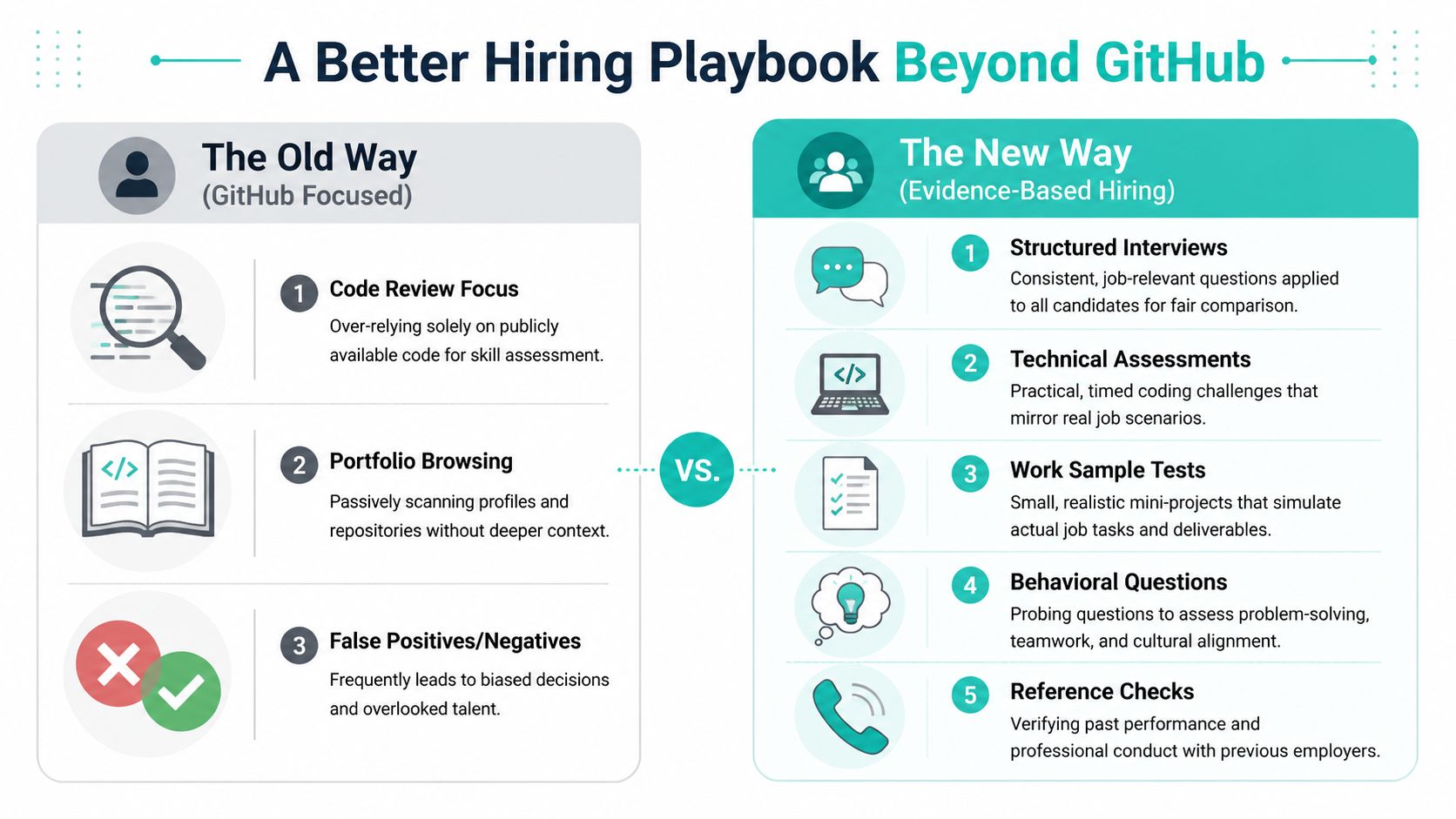
Use methods that make candidates demonstrate the work, explain their decisions, and show how they operate with other people. That's what startup hiring needs.
A common view among hiring managers in tech is that recruiters rarely scrutinize GitHub profiles at all, instead relying on resumes and LinkedIn, while technical decision-makers may treat a strong GitHub history as a proxy for real coding ability and skip or shorten certain interview stages. That implies GitHub has influence only once the candidate reaches technical evaluators, not at the initial recruiter screening layer, as reflected in this discussion among hiring professionals on Glassdoor.
That means your process needs stronger signals earlier.
Ask every candidate the same core questions for the same role. Score responses against a rubric before debrief.
For engineering roles, that usually means:
This works because it forces comparable evidence. You stop rewarding whoever has the prettiest profile and start comparing how people think.
Most startups don't need abstract puzzle performance. They need evidence that someone can handle the kind of work the team already has.
Good work samples are:
Examples help. A backend candidate might debug a failing API flow and explain likely failure points. A product engineer might extend a partial feature with clear edge-case handling. A data engineer might reason through pipeline reliability and schema changes.
Hiring heuristic: The closer the assessment is to the real job, the less you need to infer.
Behavioral rounds often fail because interviewers ask soft questions and accept polished stories. Done well, these rounds reveal the startup traits GitHub can't show.
Ask for specifics:
Listen for ownership, clarity, adaptability, and honesty. Candidates who can talk concretely about tradeoffs usually understand them.
Reference checks shouldn't be a box to tick at the end. Use them to validate the exact risks you still see.
If you're unsure about collaboration, ask about collaboration. If you're unsure about autonomy, ask where the person needed structure versus where they created it.
A process like this needs coordination. Interview kits, scorecards, stage definitions, and consistent candidate tracking matter. If your team is tightening operations around that, a practical recruitment management software guide can help you think through the workflow side, especially if interviews are becoming inconsistent across hiring managers.
The point isn't to add bureaucracy. It's to make good judgment repeatable.
Most startup teams don't fail because they lack opinions on talent. They fail because the top of funnel is full of noise.
Manual sourcing on GitHub makes that worse. You spend hours scanning usernames, repos, stale activity, and half-useful portfolios, then still have to infer whether the person wants startup work, fits the stage, and can operate in a small team.
That's not efficient screening. It's speculative archaeology.
The primary bottleneck in startup hiring isn't “where can I find more profiles.” It's “how do I get fewer, better ones.”
That's where curated talent channels make more sense than GitHub-first sourcing. Instead of starting with public artifacts and guessing fit, you start with candidates who've already been filtered for relevant experience, startup interest, and baseline alignment.
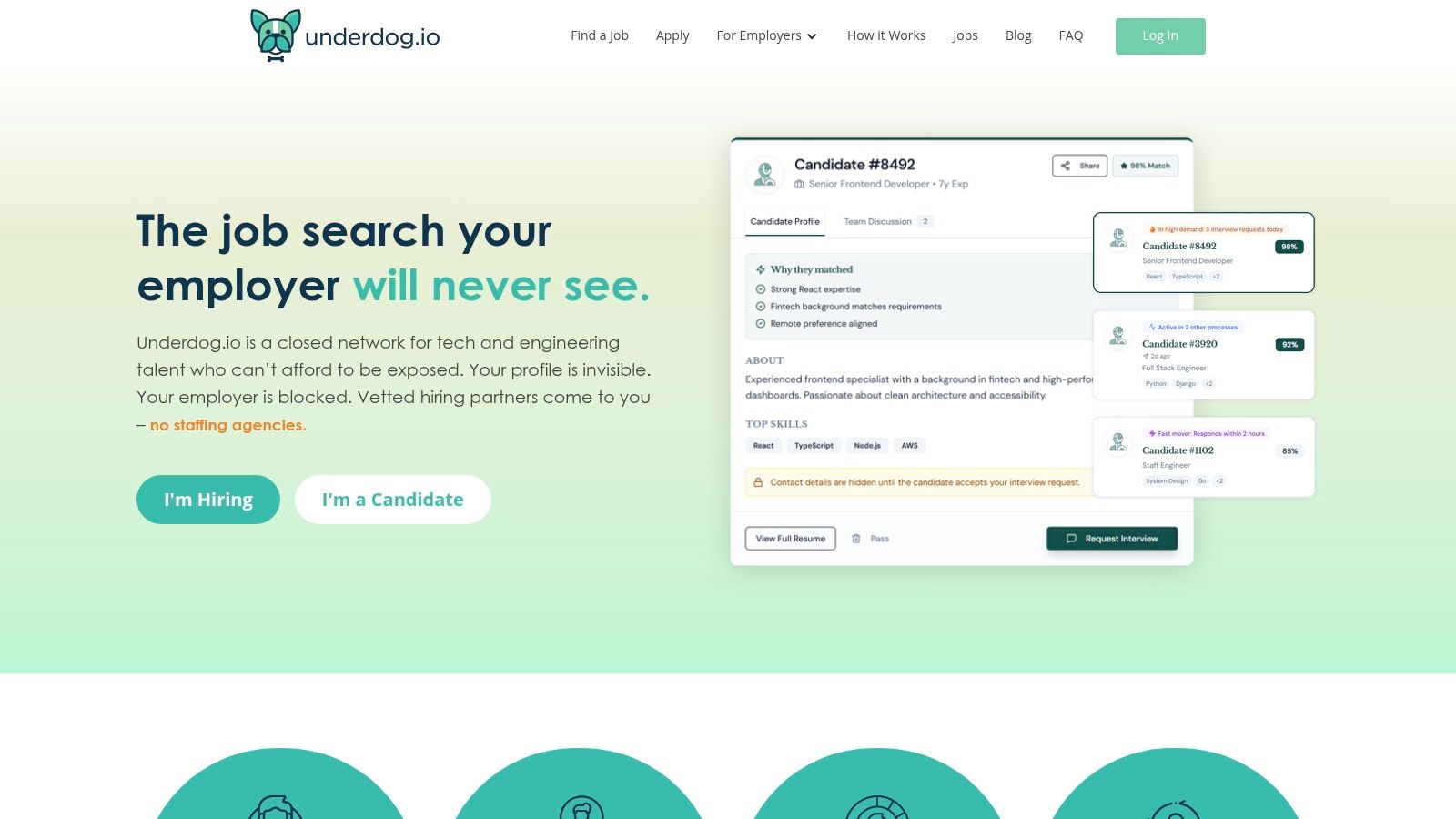
One example is Underdog.io's approach to finding software developers, which centers candidate profiles and human review rather than public code activity alone. That model is useful because it acknowledges a basic truth: strong candidates are often invisible in public repositories, but visible in the right curated funnel.
Curated marketplaces improve the process in a few practical ways:
This matters most for lean teams. A seed or Series A company can't afford a sourcing process that burns engineering hours on weak signals.
Public code is optional. Relevance, interest, and evidence of execution are not.
Curated marketplaces also help with a hiring issue that GitHub can't touch: candidate intent. A strong engineer with a great profile still may not want your stage, your domain, your compensation mix, or your working model. Human-vetted marketplaces make that visible earlier.
That makes the funnel smaller, but much sharper.
You don't need to ban GitHub. You need to demote it.
Treat it like a supplemental artifact. If it's strong and relevant, great. If it's absent, don't assume anything. Then rebuild the rest of the process around evidence that maps to startup performance.
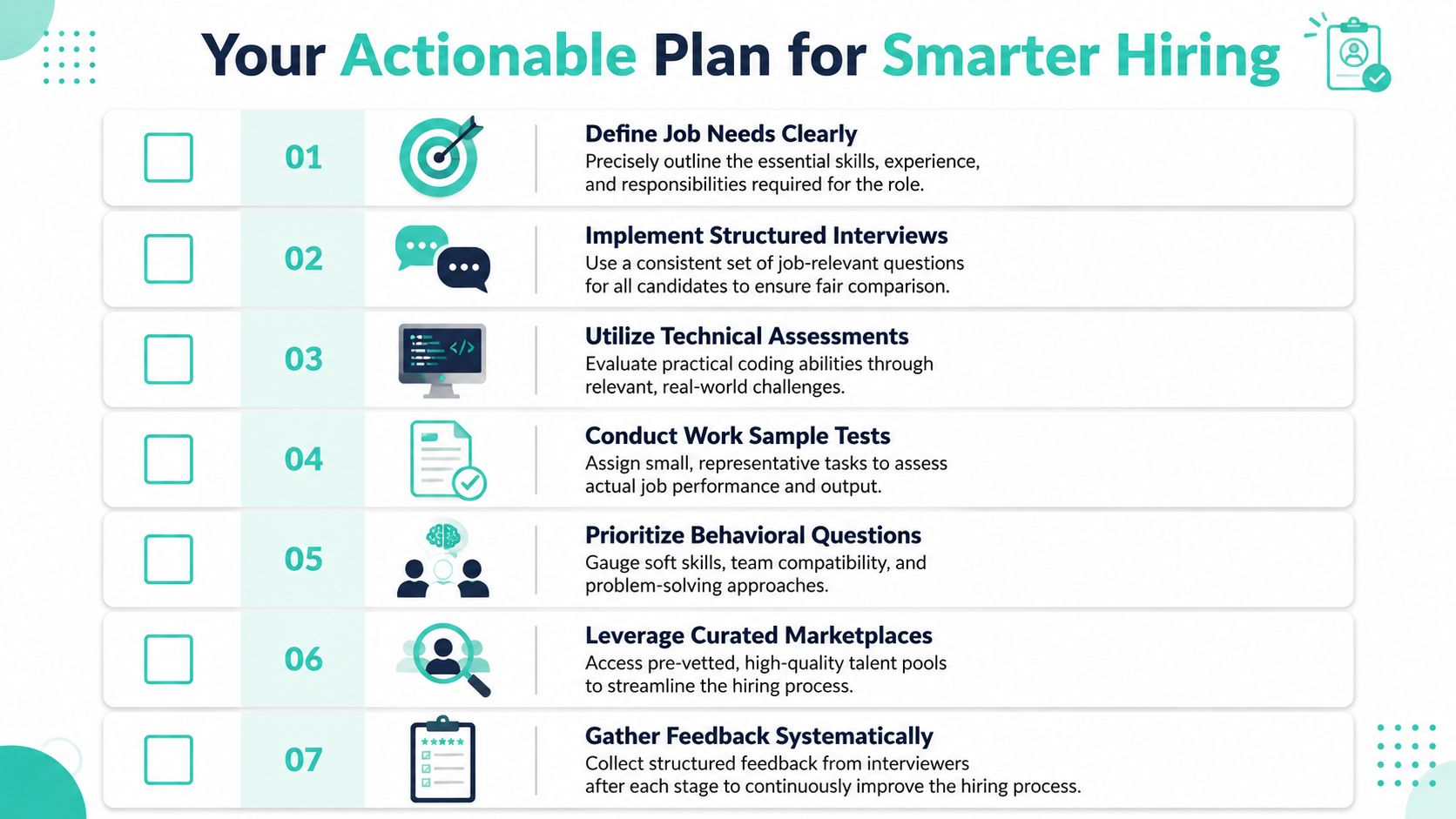
Use this checklist:
Audit your screen criteria
Look at the last few candidates rejected early. Identify where public signals, including GitHub, carried too much weight.
Write a role scorecard
Define the few capabilities that matter in the actual job. For a startup engineer, that might be debugging, tradeoff judgment, communication, and autonomy.
Standardize one interview stage
Pick one stage and make it structured. Same questions, same rubric, same interviewer notes.
Replace generic coding tests
Use a short work sample tied to the role instead of broad puzzles or portfolio browsing.
Tighten debrief discipline
Collect written feedback before discussion. That reduces halo effects from impressive resumes or polished public profiles.
Improve sourcing quality
Stop relying on broad, low-context channels as your default. Add curated or referral-driven pipelines where candidate relevance is clearer.
Review your process against broader hiring fundamentals
If your team wants a practical outside perspective, these essential hiring strategies are a useful complement to startup-specific process tuning.
Why GitHub won't help you with hiring comes down to one issue: it creates confidence without enough evidence.
That's dangerous in startups because every hire changes team output fast. Better hiring comes from structured comparison, role-relevant tasks, sharper sourcing, and disciplined interviewer judgment. GitHub can support that process. It can't replace it.
If you want a cleaner way to meet startup-ready candidates without over-indexing on GitHub, Underdog.io offers a curated marketplace where employers review vetted tech talent through richer profiles and mutual-interest matching, not contribution graphs alone.