You've made it through several interviews with a promising startup. The team is excited, the role offers more ownership than your current job, and then the offer arrives: a lower salary paired with a stock option grant that sounds generous until you try to understand it. The document mentions a percentage, a strike price, vesting, a cliff, and an exercise window, but it doesn't tell you what the package might be worth.
That uncertainty is normal, but accepting startup jobs with equity without doing the math is expensive. Equity can become a meaningful part of compensation, yet it can also disappear through dilution, taxes, missed exercise deadlines, or a company that never creates liquidity. The right decision starts with treating salary, equity, risk, and role fit as one package.
The offer letter looks simple at first. You see a salary, a job title, and a line promising stock options. Then you notice that the grant is expressed as a number of options rather than a percentage, the vesting schedule begins with a cliff, and the company hasn't explained how many fully diluted shares exist.

A grant of 0.5% can mean something very different from the same percentage at another startup. You need to know the company's capitalization, the current valuation used for option pricing, the expected dilution from future fundraising, and whether the business has a realistic path to an exit. A headline percentage is only the starting point.
In Silicon Valley, startup employees received stock options worth about 12% to 14% of salary on average in 2022, according to Secfi's 2022 State of Stock Options report. An employee earning $150,000 could therefore receive roughly $21,000 in option value as part of total compensation, although that figure represents potential value rather than guaranteed cash.
That distinction changes the conversation. You aren't comparing a certain salary dollar for dollar with a speculative asset. You're comparing present income with a claim on a company whose future value, dilution, tax treatment, and liquidity remain uncertain.
Use this guide to accepting a job offer as a broader reminder to evaluate the full employment agreement, not only the equity paragraph. Ask for the grant agreement and plan documents before you make a decision.
Practical rule: Never negotiate from the percentage alone. Ask what the percentage represents, how it was calculated, and what you must pay or do before you can realize any value.
The candidates who leave satisfied usually understand the trade-off they accepted. They know how much cash they're giving up, what outcome would make the risk worthwhile, and which conditions could make the equity worthless. Candidates who leave disappointed often accepted an impressive-sounding grant without asking those questions.
Public job boards make it easy to apply and difficult to judge quality. You can spend hours submitting applications to companies that disclose little about compensation, ownership, funding, or the people making the hiring decision. A targeted search produces better information earlier.
Start with a shortlist of companies whose product, stage, and working style fit your risk tolerance. Then use several channels deliberately:
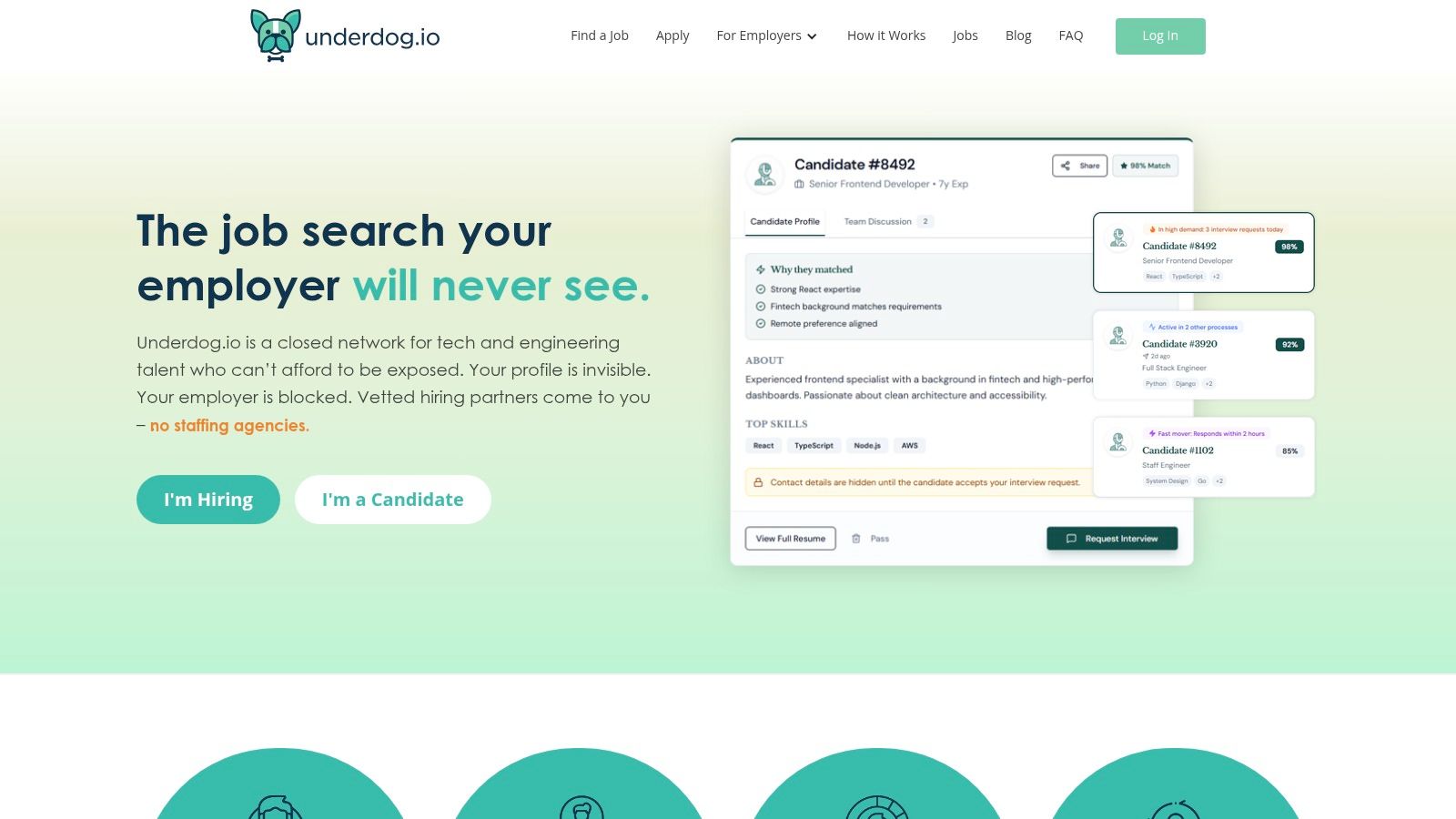
A curated marketplace works differently from a high-volume job board. You create a profile that communicates your experience, preferred environment, and target role, then allow relevant employers or matching teams to find you. That can shift the interaction from proving that you noticed a posting to discussing whether the opportunity fits.
The advantage isn't only convenience. Selective visibility gives you room to ask sharper questions before you become emotionally invested in one company. You can compare how different startups explain equity, whether they disclose the grant as a percentage of fully diluted ownership, and whether salary changes with the stage of the business.
Prepare a concise candidate narrative before you join these channels. State the problems you solve, the scope you've owned, the kind of ambiguity you handle well, and the conditions under which you'd trade cash for upside. Founders want evidence that you can operate without a large support structure, not a generic declaration that you're passionate about startups.
A warm introduction isn't a substitute for research. It's an opportunity to ask better questions earlier. Before the first serious interview, clarify whether the company shares the option count, fully diluted share count, strike price, vesting terms, and post-termination exercise rules.
You should also ask why the role is open, what success looks like, and which decisions the person will own. Equity has more potential value when your work can materially influence the company, but title and proximity to leadership don't guarantee that influence. The quality of the role remains part of the package.
Stock options give you the right to buy shares later at a fixed strike price. Restricted Stock Units, or RSUs, promise shares that are delivered when they vest, so there's no purchase decision at the point of settlement. The distinction affects cost, taxation, timing, and downside.
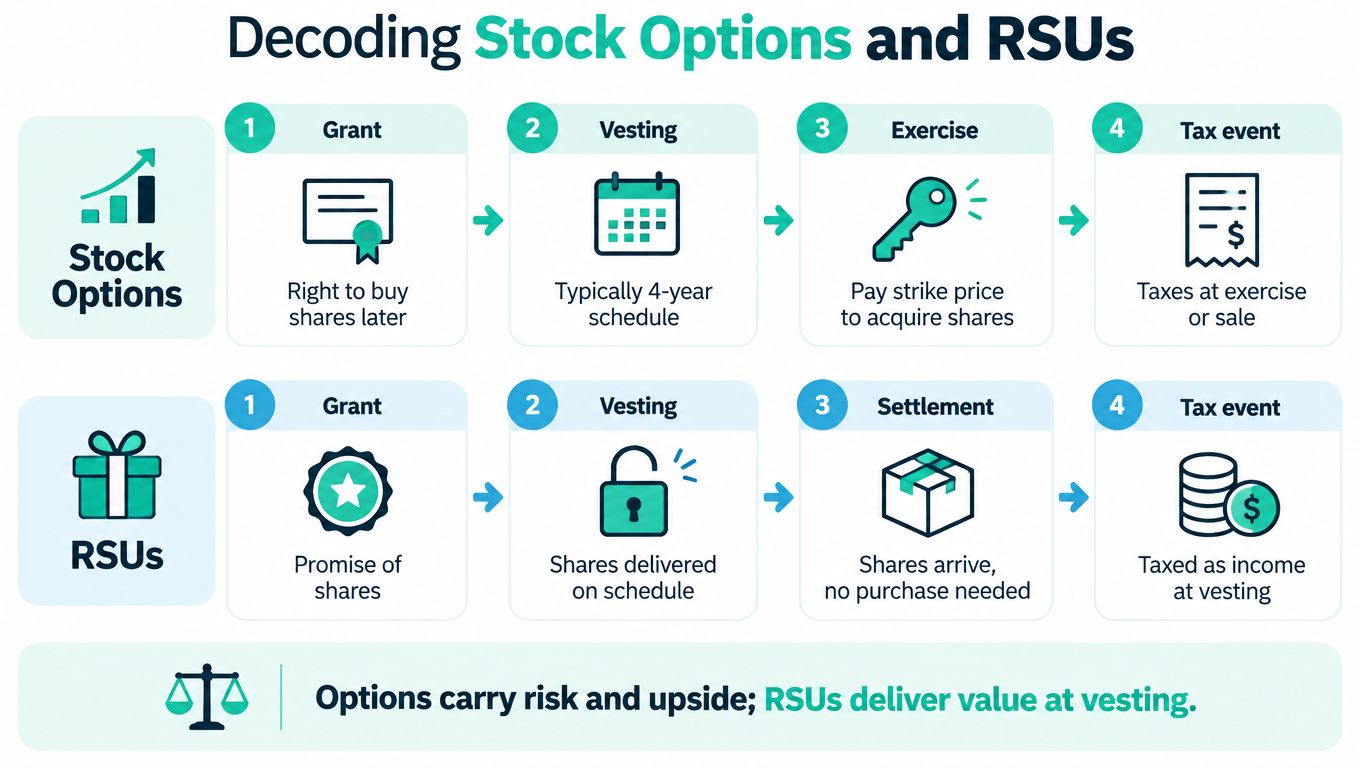
With options, the strike price matters because you must pay it to acquire the shares. If the company's current share value is only slightly above that price, your potential gain may be narrow. If the value falls below the strike price, exercising may make no financial sense.
RSUs remove that purchase price, but they aren't automatically safer in every context. They're more common when a company has a clearer share value, while private startup options can carry greater uncertainty and potentially greater upside. Tax rules depend on the jurisdiction and instrument, so a guide to RSUs in Canada can help Canadian candidates identify questions to raise with a qualified adviser.
The first calculation is straightforward:
Ownership percentage = grant size ÷ fully diluted shares
If the offer gives you only an option count, ask for the denominator. Without the fully diluted share count, you can't tell whether the grant is meaningful or merely large in absolute terms.
Early hiring is where equity tends to be most concentrated. One market guide reports that first employees at funded startups often receive 0.5% to 4%, with a median of about 1.49%. The same guide places the median grant around 0.85% for the second hire and 0.18% for the tenth hire, while the first five employees collectively receive a median of 3.62%. These figures from Kruze Consulting's startup compensation guide illustrate why stage and hiring order matter.
Role also changes the range. A commonly cited framework places key executives at 1% to 3%, early technical individual contributors at 0.5% to 1%, and early commercial individual contributors at 0% to 0.5%, as outlined in Stripe's equity guide. Treat these as negotiation context, not a promise of market value.
A common startup structure uses four-year vesting with a one-year cliff. You receive nothing during the first 12 months, then 25% vests at month 12, with the remaining 75% vesting over the next 36 months, according to Alcor's equity allocation guide.
Your offer review should therefore include:
For a deeper technical explanation, this engineer's guide to stock options is useful preparation before negotiating with a founder or finance lead.
A percentage grant is not a permanent percentage of the company. When a startup issues new shares during fundraising, your ownership percentage can shrink unless your grant is increased. The company's value may rise while your share of that value falls, so you need to model both growth and dilution.
The option pool adds another layer. Early-stage companies commonly reserve 10% to 15% of fully diluted shares for employees, while broader market ranges can reach 13% to 20%, according to Haven's startup equity overview. Ask whether the stated percentage is calculated before or after the pool and whether planned hiring will expand it.
A useful offer review has three views:
| Question | What to examine |
|---|---|
| Ownership | What percentage does the grant represent today? |
| Economics | What is the difference between the expected share value and strike price? |
| Access | Can you afford exercise, taxes, and the waiting period before liquidity? |
The third question is where many candidates underestimate risk. Carta reported that only 32.2% of vested, in-the-money options were exercised in Q4 2024, down from 54.2% three years earlier. Carta also reported an exercise rate of 28% in Q1 2023. Those figures appear in Carta's startup compensation data, and they show why vested value shouldn't be treated as cash in the bank.
Exercise can require a large upfront payment before you have any way to sell the shares. Tax treatment may create an additional burden, particularly when a private valuation rises without a public market. A candidate with limited savings may rationally prefer more salary, even if a wealthier candidate accepts the same equity grant.
Your options may be vested and still become unusable if you can't exercise them within the post-termination window. Ask whether the company offers an extended period, whether it runs tender offers or buybacks, and whether you can sell shares in a secondary transaction.
Use an equity dilution calculator to model low, middle, and high exit outcomes rather than anchoring on the latest valuation. The objective isn't to predict the future. It's to understand what must go right before the equity compensates you for the salary and liquidity risk you accepted.
Negotiation is expected in startup hiring, but the strongest discussions are precise. Don't say that the offer “feels low.” Explain the trade-off you're being asked to make and propose a structure that reflects your constraints.
A practical script sounds like this:
“I'm excited about the role and the scope. The base salary is below what I need to accept the risk of leaving my current position. Could we raise the salary, or revise the grant based on fully diluted ownership and the exercise terms?”
That framing keeps the conversation commercial rather than adversarial. You're showing that you understand the company has limited resources while making clear that speculative equity can't replace every dollar of dependable income.
Salary usually deserves more weight when you have fixed financial obligations, dependents, limited savings, or unvested compensation you'd lose by leaving. Equity can deserve more weight when the company is early, the grant is transparent, the role has substantial influence, and you can tolerate the possibility that the equity never pays out.
The stage matters, but it doesn't decide the answer by itself. Earlier companies may offer a larger ownership percentage and less certainty. Later companies may offer a smaller grant with a clearer valuation, stronger cash compensation, and a more developed path to liquidity.
If the company can't move on salary or percentage, ask about other levers:
A smaller grant with fair terms can be more useful than a larger grant that expires quickly or requires cash you don't have. Conversely, don't accept a weak salary merely because the founder describes the equity as “life-changing.” Ask for the documents, calculate the ownership, and decide whether the opportunity works under a conservative outcome.
Equity becomes a warning sign when the company uses it to avoid discussing present compensation or refuses to explain what you're receiving. You don't need every confidential investor document, but you do need enough information to understand the instrument and the conditions attached to it.
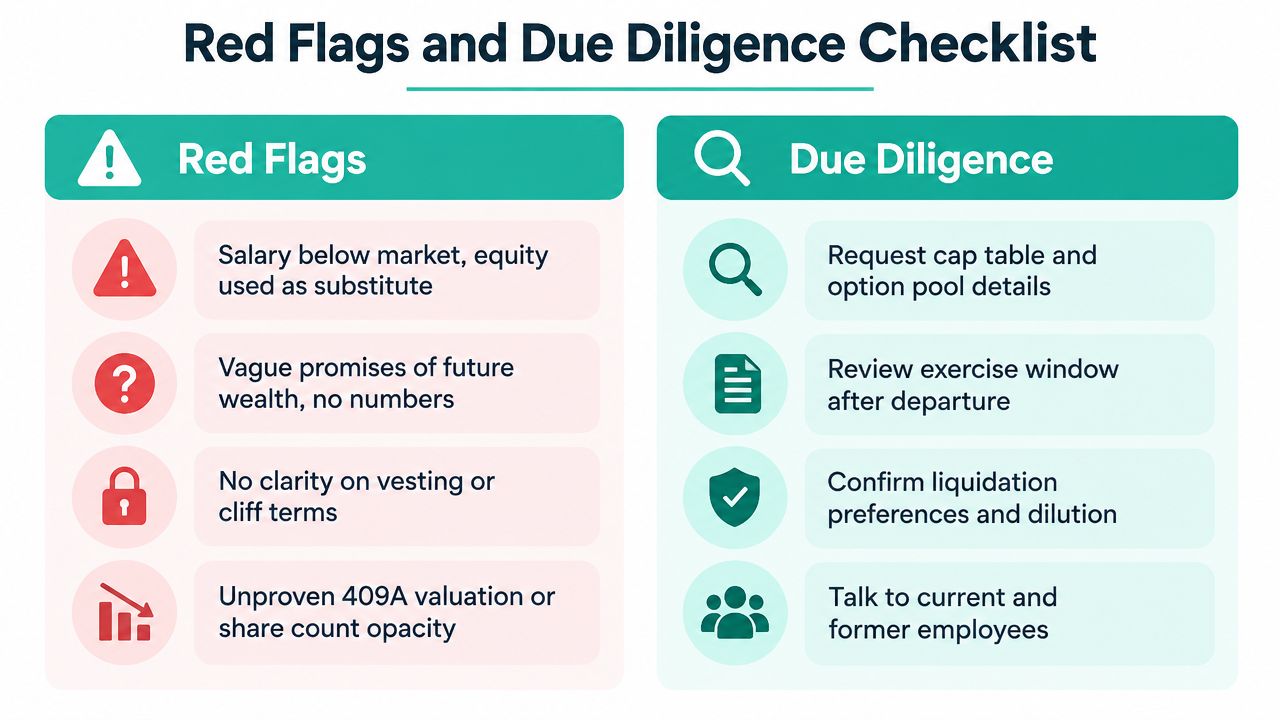
A private company may not share every detail of its cap table. That doesn't excuse a vague offer. Before signing, request the following in writing:
The practical guide from Underdog on evaluating jobs with equity identifies opaque grant sizes, missing 409A information, unclear vesting, short exercise windows, and hidden dilution as common reasons equity looks valuable but fails in practice.
Treat one missing detail as a question and several missing details as a decision problem. A company that answers clearly, even when the answer isn't attractive, gives you information you can price into the decision. A company that changes the subject or pressures you to sign before reviewing the plan creates avoidable risk.
Talk with current and former employees where possible. Ask whether the company communicates funding and valuation changes, whether managers understand the equity plan, and whether anyone has successfully exercised or sold shares. You can also browse startup legal articles to build vocabulary before speaking with an attorney.
Use staffing partners such as nexusITgroup.com for broader market context on comparable technology roles, but don't outsource your legal or tax review. A recruiter can help you compare offers. A qualified adviser should handle jurisdiction-specific questions about exercise, tax, and shareholder rights.
The strongest candidates for high-growth roles don't market themselves as people who merely want startup equity. They show that they can create value before the company has mature processes, large teams, or complete information. That story should appear consistently in your resume, profile, conversations, and negotiation.
Lead with evidence of ownership. Describe the product decision you drove, the system you made reliable, the customer problem you resolved, or the team you helped coordinate. A startup hiring manager needs to see how you behave when priorities change and when no one has written the process yet.
Your resume and LinkedIn profile should make three qualities visible:
Avoid turning every bullet into a technology inventory. “Built a service” says little without the problem, constraint, and responsibility attached to it. A concise description of the decision you owned gives a startup more useful information than a long list of frameworks.
Research the product, customers, competitors, and likely operating constraints before the interview. Then explain why your experience is relevant to this particular team. “I like fast-paced environments” is generic. “I've worked on products where customer feedback changed the roadmap, and I want a role where I can stay close to that feedback” communicates a working preference.
Your questions should reinforce the same narrative. Ask what the role owns, which decisions require founder approval, how the company measures progress, and what the team expects the person to accomplish before the first review. These questions help you assess role fit while showing that you think beyond the job description.
Before accepting, score the offer across four dimensions:
A compelling role should hold up even after you discount the equity heavily. If the answer depends on a perfect exit, immediate promotion, or an assumption that dilution won't matter, the package isn't as strong as the headline suggests. The right startup job isn't the one offering the largest percentage. It's the one where the cash, ownership, responsibilities, and personal risk make sense together.
Underdog.io connects tech candidates with vetted startups and high-growth companies, giving you a focused way to explore roles where salary and equity can be discussed with greater clarity. Create a profile and visit Underdog.io to compare opportunities that fit your skills, stage preferences, and approach to startup risk.